


Formula One: Built to Win
The Best Game That Absolutely No One Played
NES collectors, Let’s Players, historians, indiscriminate ROM hoarders, Reddit threads: throw enough enthusiasts together and eventually you’ll get a debate over the console’s hidden gems, overlooked games that deserved a wider audience. Four decades after the console’s US release there are still games buried in unwarranted obscurity, despite the subsequent years of emulation, collector archiving and a cottage industry of console retrospectives.
Who doesn’t have their own stock answer? It’s not uncommon to find defenses of The Guardian Legend, Kabuki: Quantum Fighter or Shadow of the Ninja. There’s a lot of depth in late-era obscurities like Cowboy Kid and The Lone Ranger if you’re willing to be patient with them. Certain collector’s items have the uncommon distinction of being rare and good (Zombie Nation, Metal Storm, Chip and Dale Rescue Rangers 2). There’s an entire sub-genre of Mega Man homages that hold up on their own (Power Blade, Little Samson, The Krion Conquest). The Scott Pilgrim books and film put a spotlight on Clash at Demonhead and Crash ‘n’ the Boys Street Challenge. Even games that are now considered classics like River City Ransom were overlooked at the time, only to find acclaim with the widespread adoption of emulation.
But man, virtually no one—ever—goes to bat for Seta’s Formula One: Built to Win. It’s surprising that it has remained so obscure after all of these years. There’s a reasonable case that it’s the best racing game on the NES.
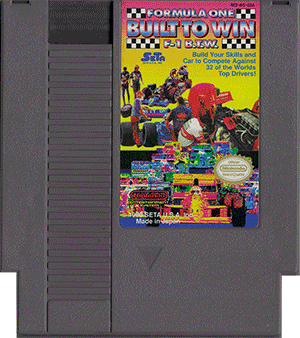
Formula One: Built to Win
Release date: 1990
Publisher: Seta
Developer: Winky Soft

Simulators, or any games with an assumption of realism, were usually rough fits for the NES. You can point to any number of reasons for this, but the most glaring were the limitations of inputs and interfaces. The game pad’s two buttons weren’t well suited for the complexities of menu-driven UIs, and they lacked the fidelity to simulate the intricacies of a flight yoke or steering column. Besides, 8-bit graphics typically benefited from a layer of abstraction. Severe resolution limits served the elemental simplicity of series like Mega Man and Super Mario Bros. more than games striving for photorealism. This isn’t intended as a value judgement; it’s just more efficient to render a killer robot piranha than, say, a three-dimensional runway approaching from a few thousand feet.
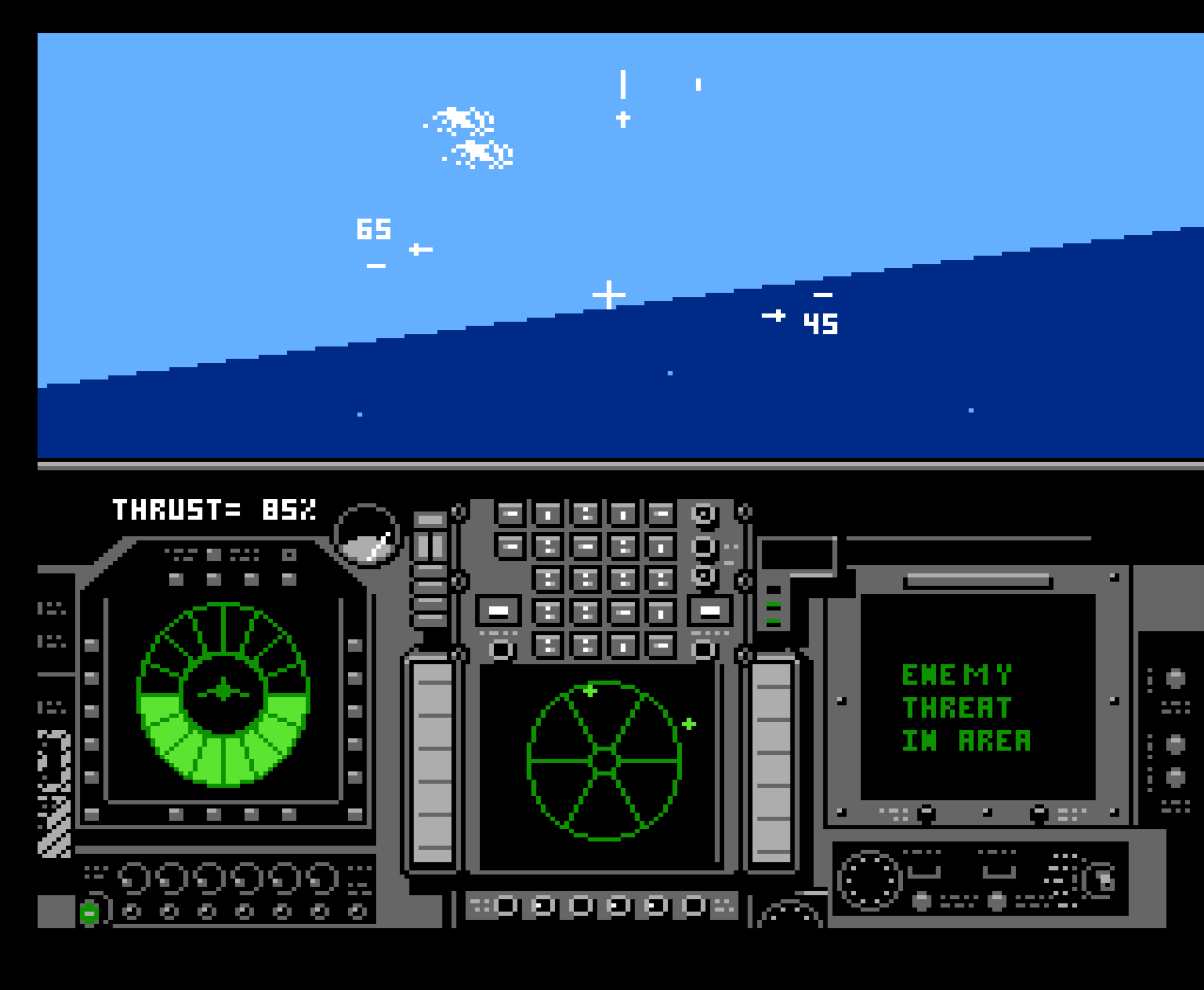
Flight sims (Stealth ATF, Flight of the Intruder) and space sims (Star Voyager) could simulate 360 degrees of motion, but usually at a sluggish chop and—without visual context in their 3D space—often felt empty. Top Gun’s landing sequences were notoriously confusing.
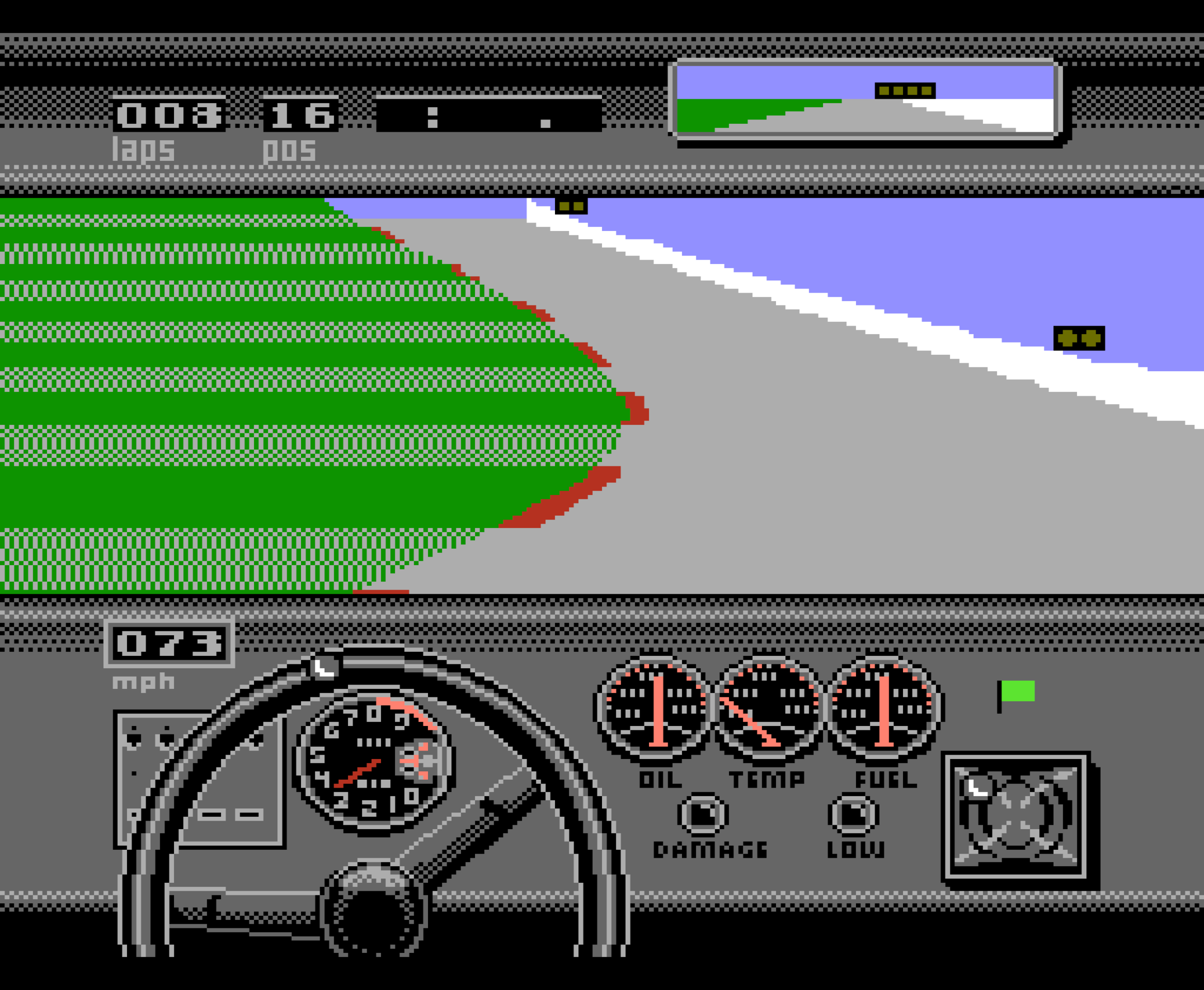
Racing sims on the NES came in all stripes, but the games that emphasized realism (Bill Elliott’s NASCAR Challenge, Michael Andretti’s World Grand Prix) tended to move slower and with a greater focus on navigating their cars’ mechanics.
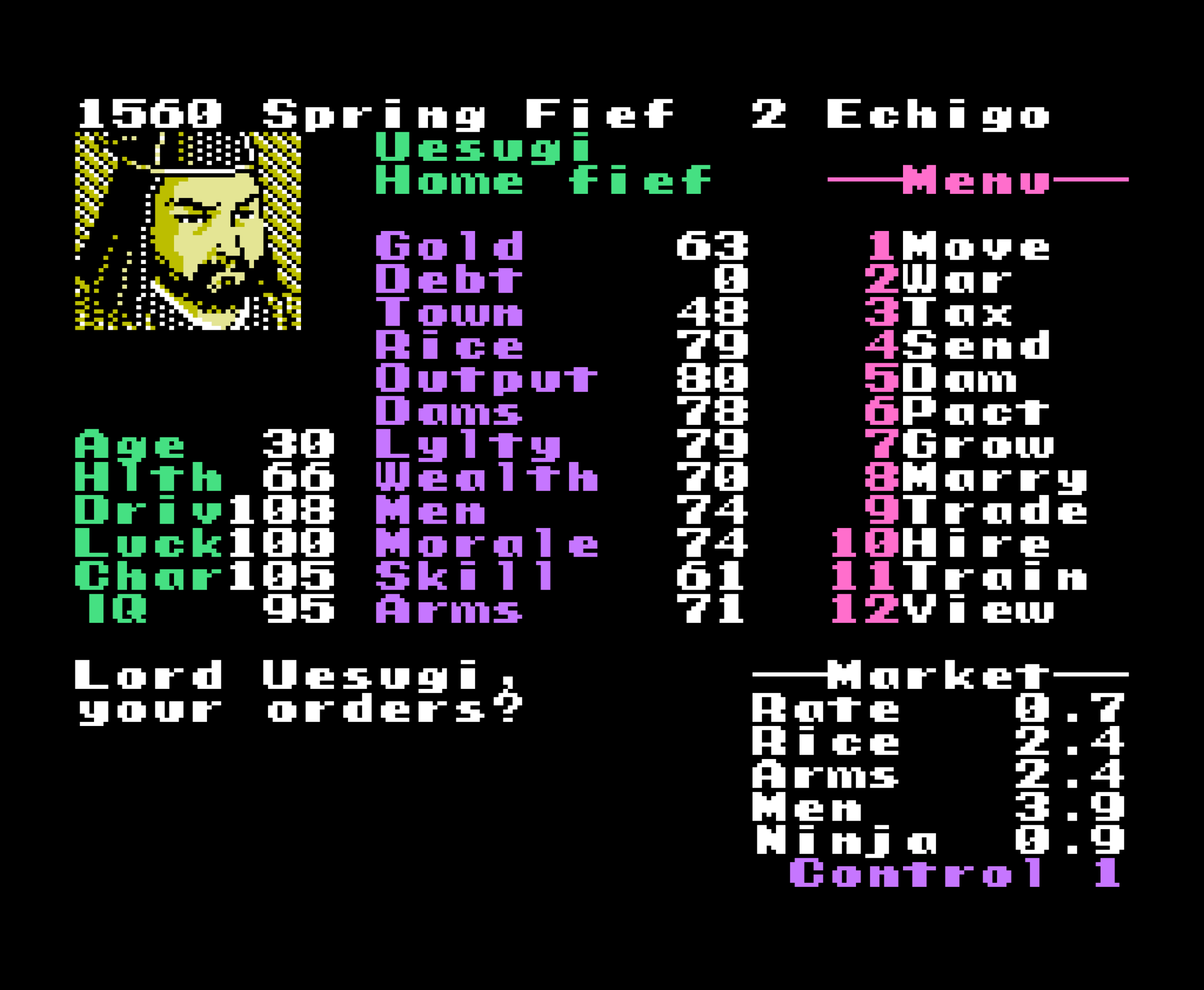
PC-style military sims sometimes fared better (typically Koei games: Nobunaga’s Ambition, Romance of the Three Kingdoms), but their complex user interfaces were often too much to distill to the NES’s two-button controller and text character limits.
This list could continue, setting aside oddities like Silent Service or Garry Kitchen’s Battletank. These games often sacrificed the responsive gratification of a fast-paced action game for slow-burn strategic depth, but technological limitations left developers unable to deliver either, typically leaving players with the worst of both worlds. It was reasonable to be wary when cover art promised realism.
F1, By the Way
So if we’re judging games by their covers, Formula One: Built to Win has to start at a disadvantage. Everything here suggests a dry experience bound by slavish devotion to gearhead minutia. A pull quote promises the chance to, “Build Your Skills and Car to Compete Against 32 of the World’s Top Drivers!” The artwork is a chaotic collage of F-1 racer imagery. It depicts a series of pit crews tinkering with half-built cars, floating in a void free of any racing context. The only imagery of cars in motion gets shunted to the bottom and layered under a very-Nineties posterization effect, suggesting this is a disposable part of a game that needs a little extra visual panache to entice people not predisposed to tinkering under the hood. It would be fair to see this and shrug it off as a Formula One equivalent of something like Out of the Park Baseball or Football Manager.
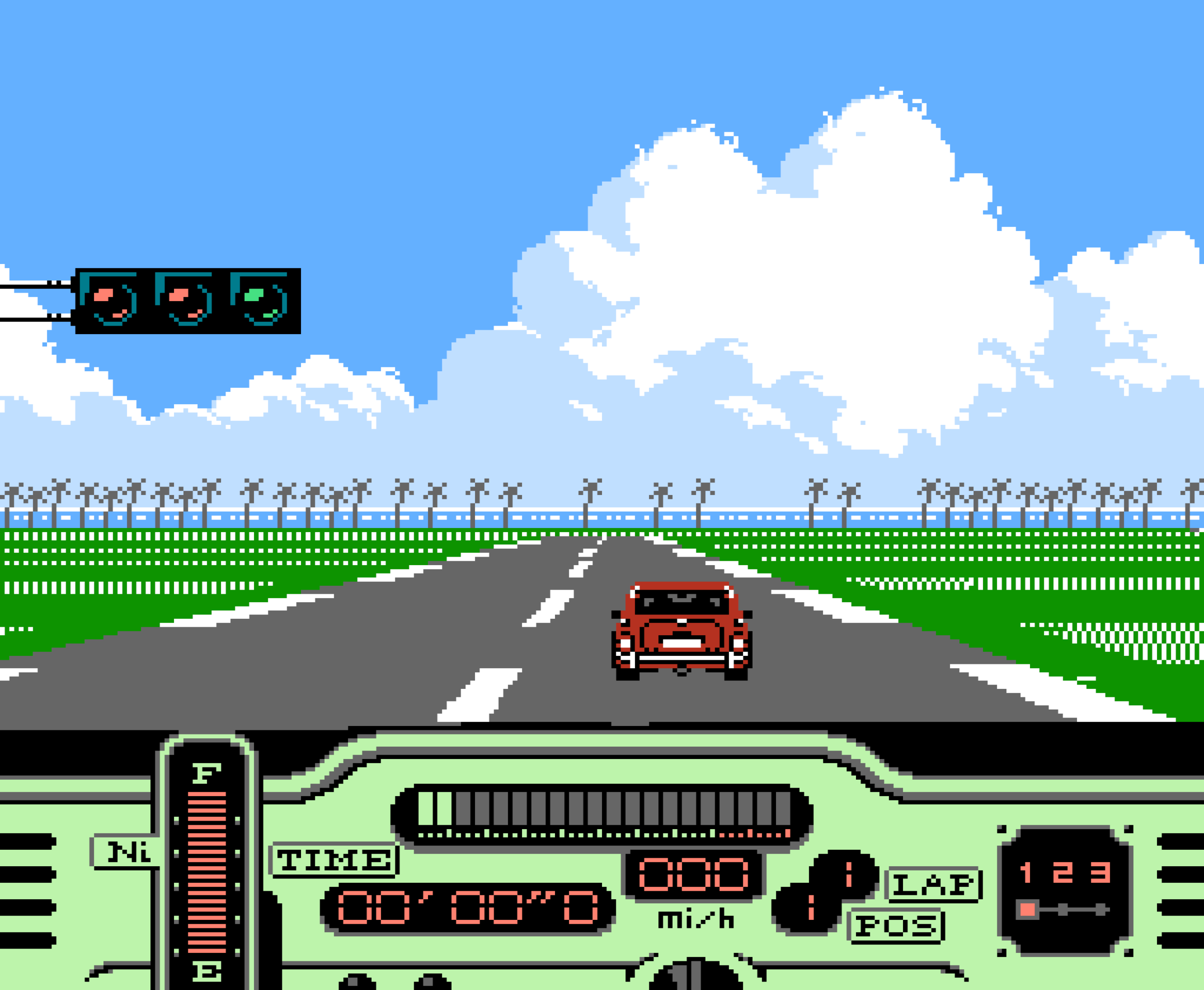
Despite these sim trappings, F1:BTW could be summarized as Rad Racer with a surprising amount of RPG depth. It plays from the same point of view—a behind-the-car perspective driving into a simulated vanishing point, with a dashboard lower-third providing most of the game’s UI—and its challenge is essentially breaking through turns just enough to keep on the road while trying to outmaneuver slower cars ahead of you.
The primary difference (other than some graphical tradeoffs between F1:BTW’s detailed background sprites and Rad Racer’s focus on hillier terrain) is found between each race. F1:BTW is defined by its extensive career mode. From the outset you are presented with a—to put it kindly—abstracted map of the United States. You are free to poke around each of the ten locations depicted, but the implicit goal becomes clear right away: you have to race your way from New York to Hawaii by leveling up both your car and driver’s rank. Both ultimately boil down to winning races, but a great deal of the game’s strategy lies in how you spend your winnings.
Even the title is misleading; players begin the game in a Mini Cooper, then advance to a Vector W2 and eventually a Ferrari F40, assuming they can scrape together $200,000 in winnings. F1 cars don’t become available until the very end of the career mode, and even then it’s in something of a new game plus mode on a separate circuit of international grand prix tracks.
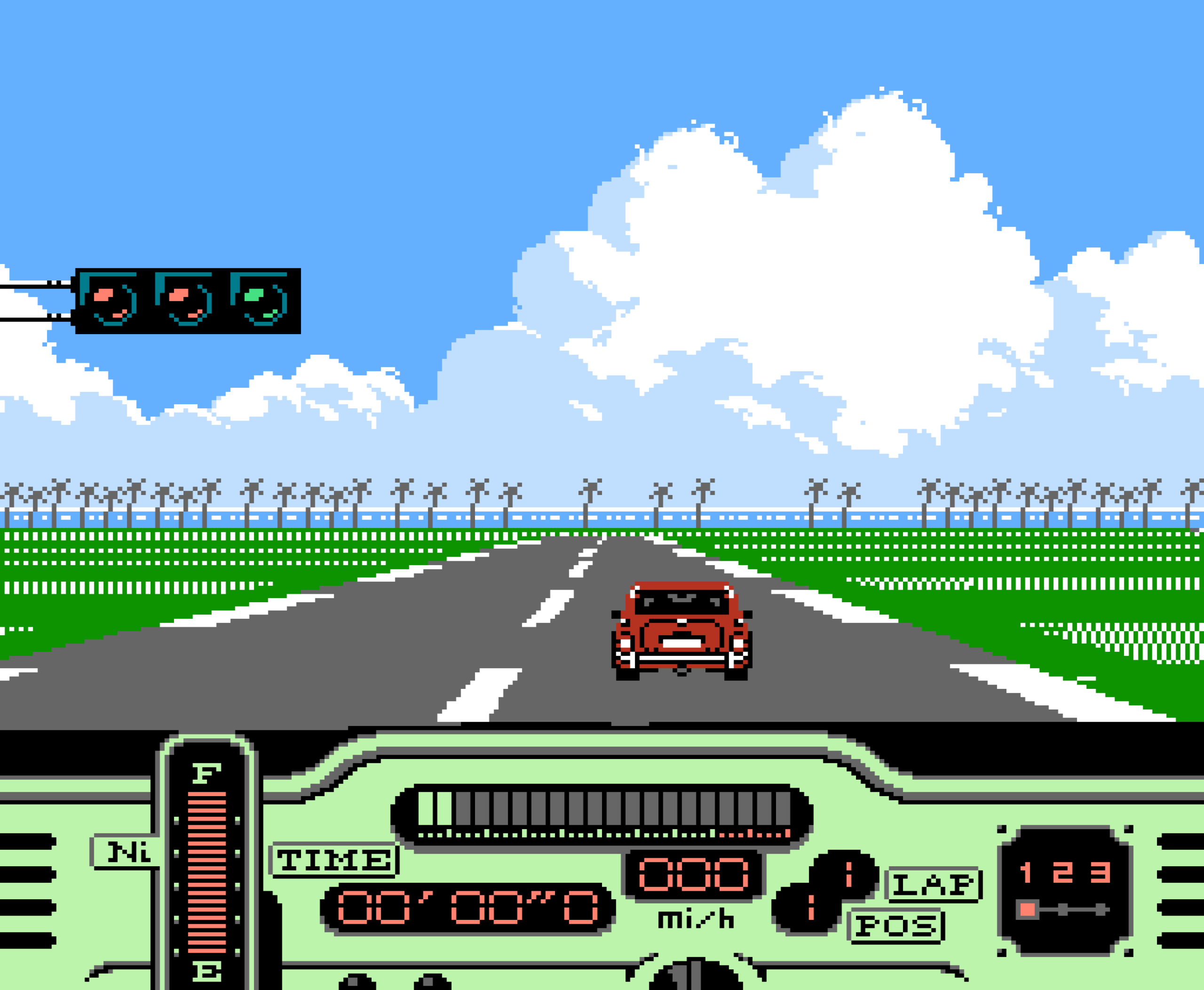
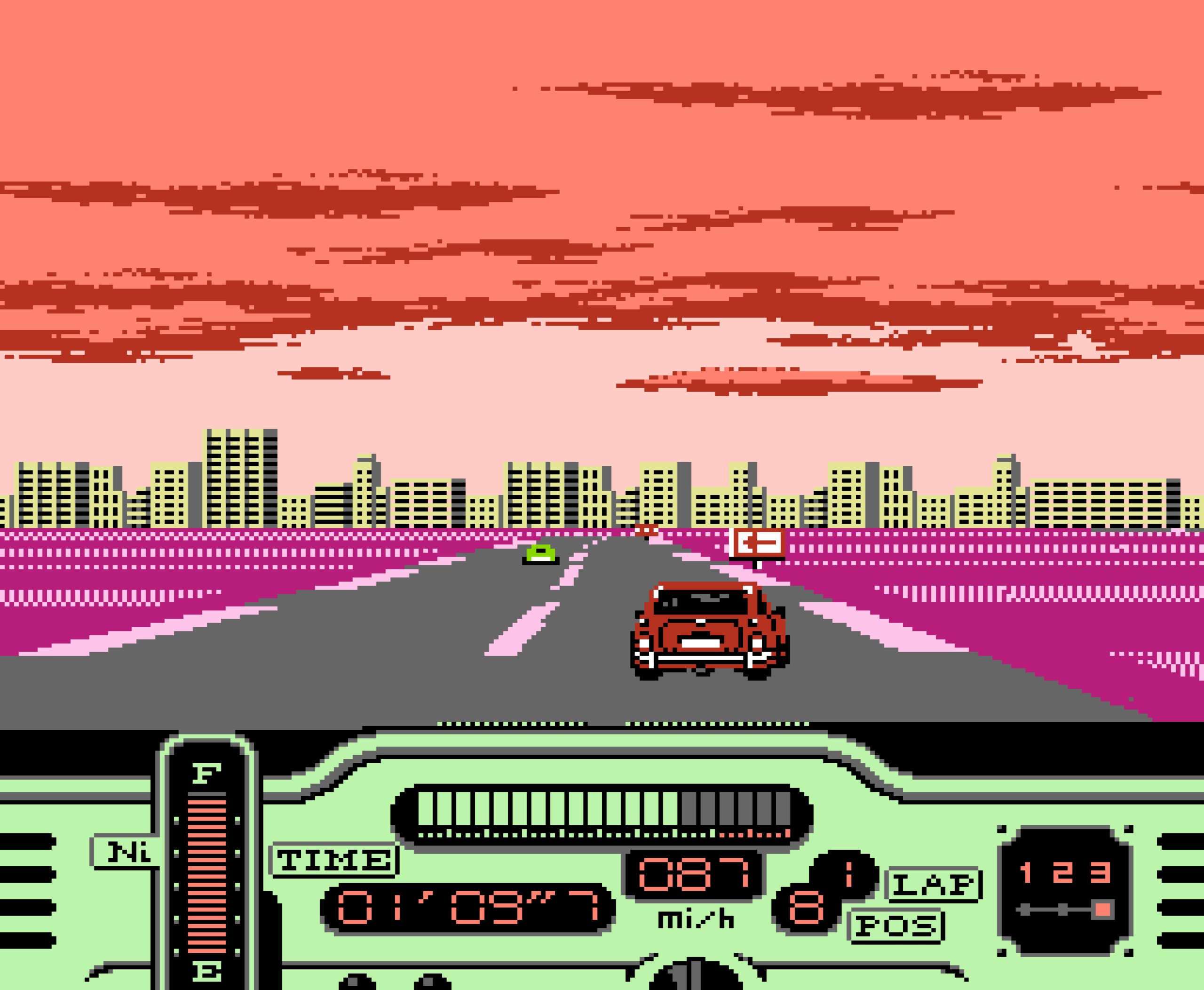
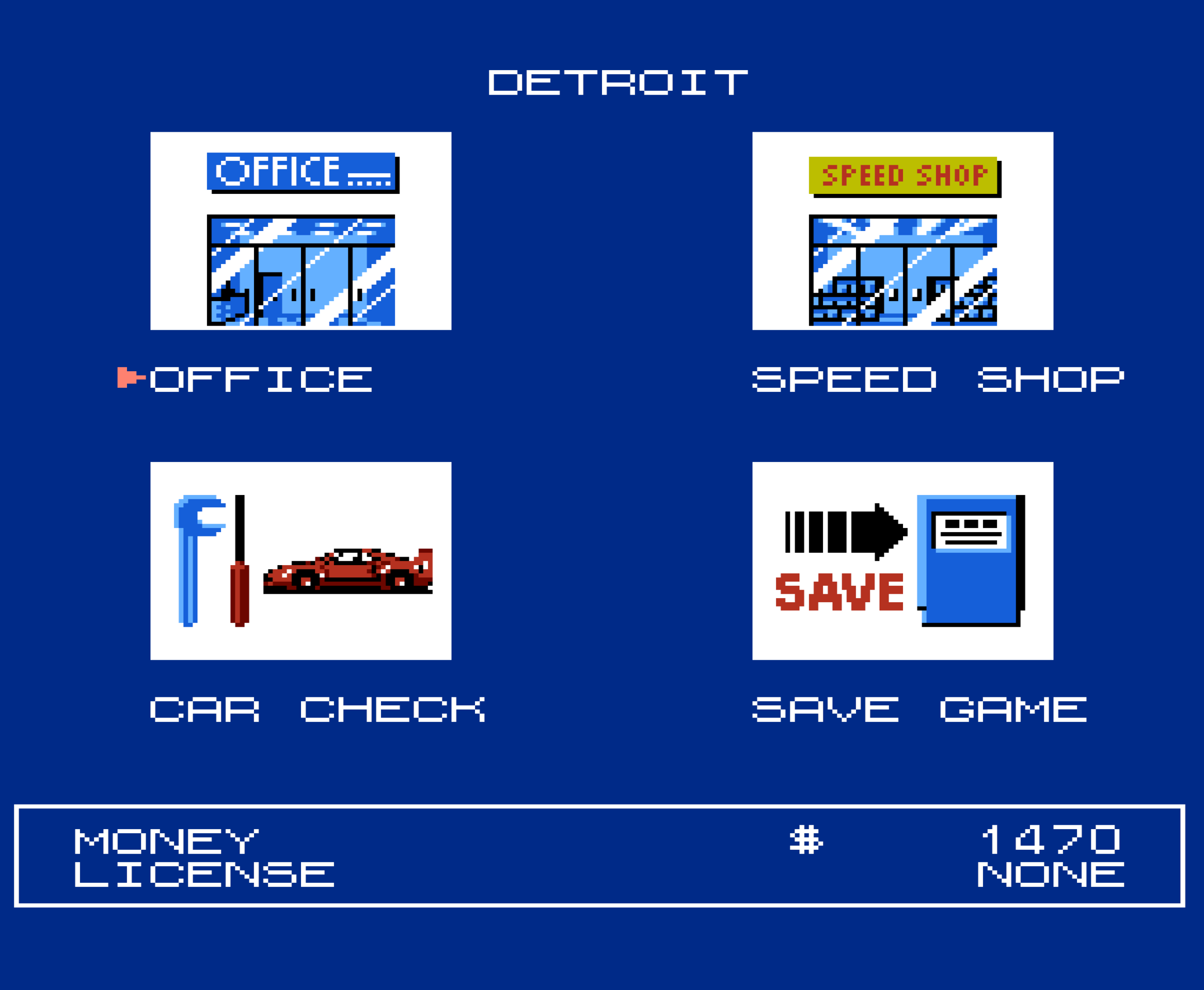
Early races are manageable with your stock Mini Cooper. Brake enough to avoid sliding through turns and use your boosts tactically and you can get through the first few races in New York, but it quickly becomes clear that you will need to invest in upgrades in order to keep pace. The game’s locations each have four menu options: an office where you can register for races, a chance to save your game, a “car check” that will show your current stats, and a fourth option that is typically an upgrade shop. (The game throws a few curveballs here. Detroit and San Francisco have “speed shops” that will buy back old parts, Dallas has a new car dealer, and Las Vegas hosts a casino where you can bet your earnings in an in-game slot machine.)
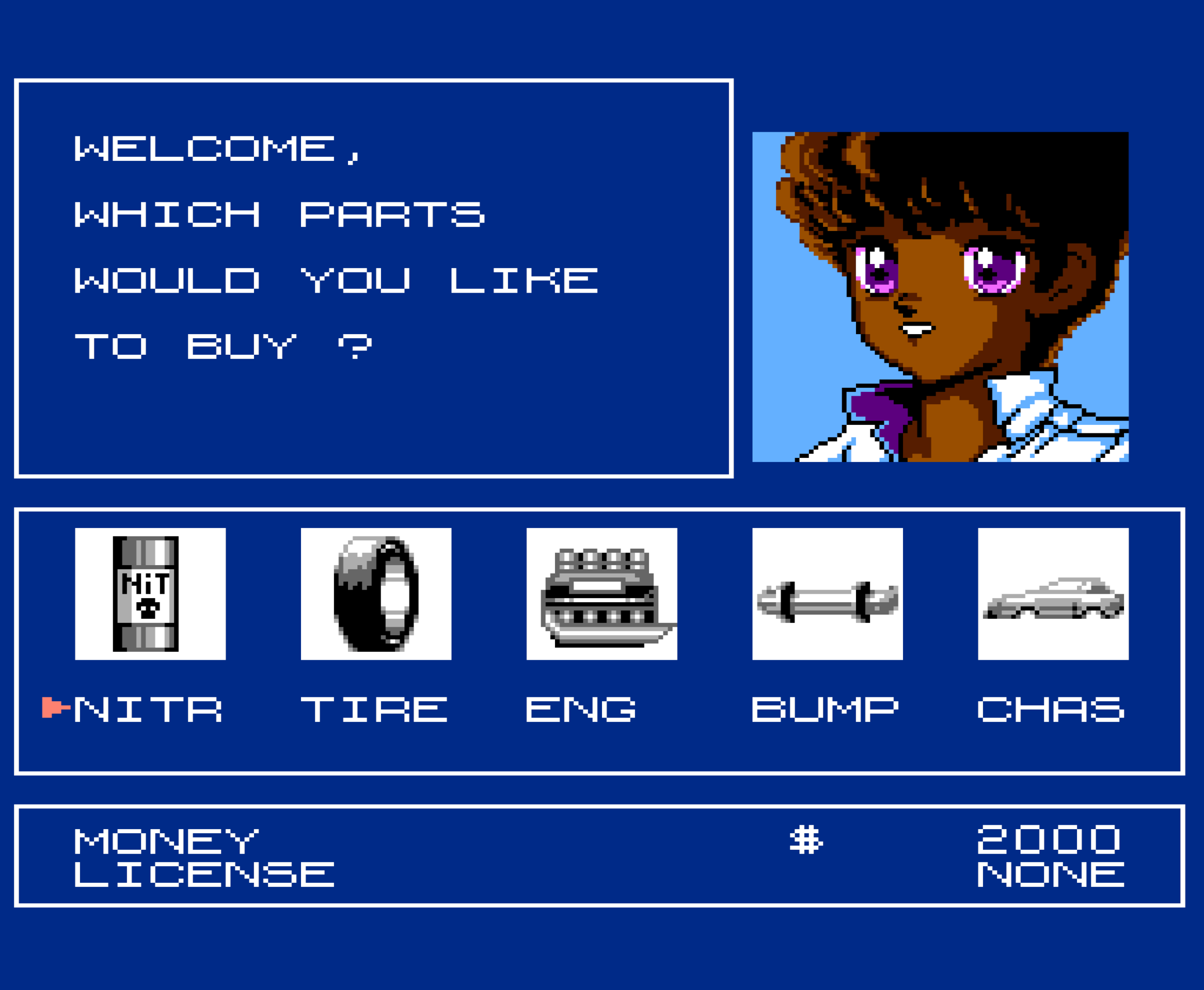
These upgrades are vital. F1:BTW gives you a variety of parts to choose from: tires, engines, bumpers, chassis, turbochargers, suspensions and breaks. Some upgrade your top speed or acceleration, others allow for better handling; new tires make turns noticeably more forgiving, while a better bumper will allow you to endure collisions with NPC cars without spinning out on contact. Advancement through the initial stages requires a finely-tuned vehicle, while balancing the cost of refilling your nitrous, which has its own meter that needs to be managed between races. After enough modification your humble Mini starts to feel like an RPG character. It’s a little dismaying, during your stop in Dallas, to leave it behind for a better car.

“Built to Win”
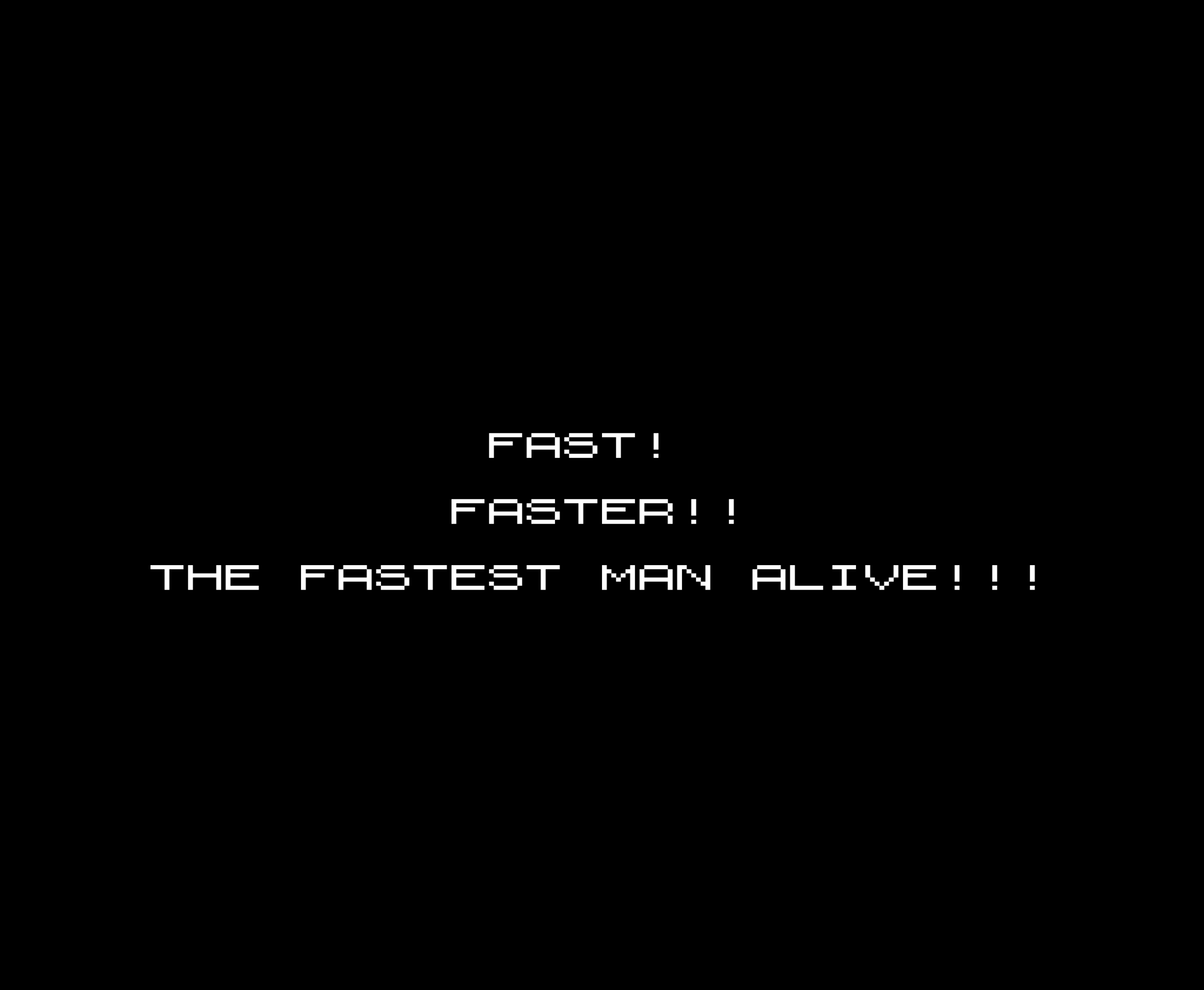
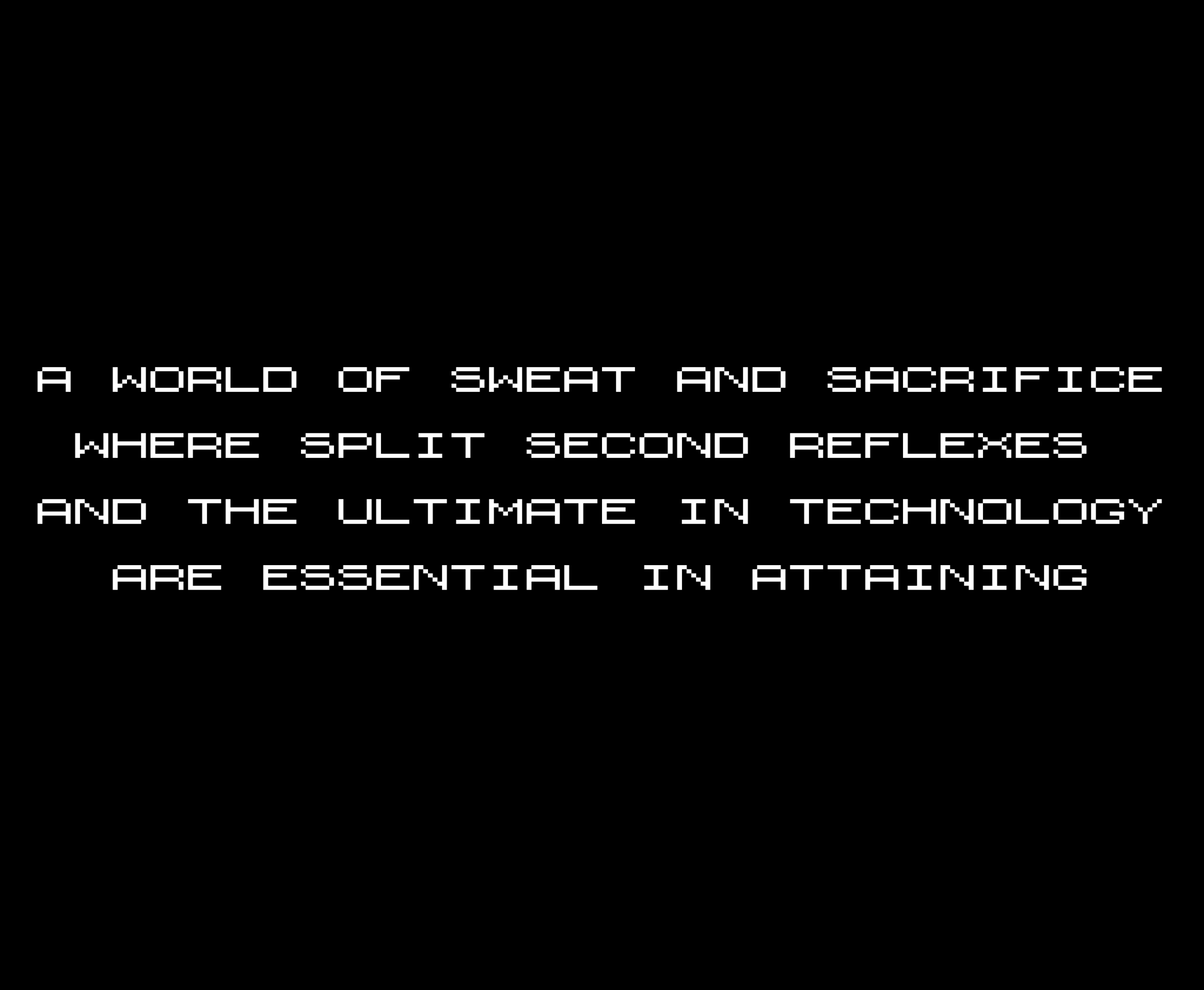
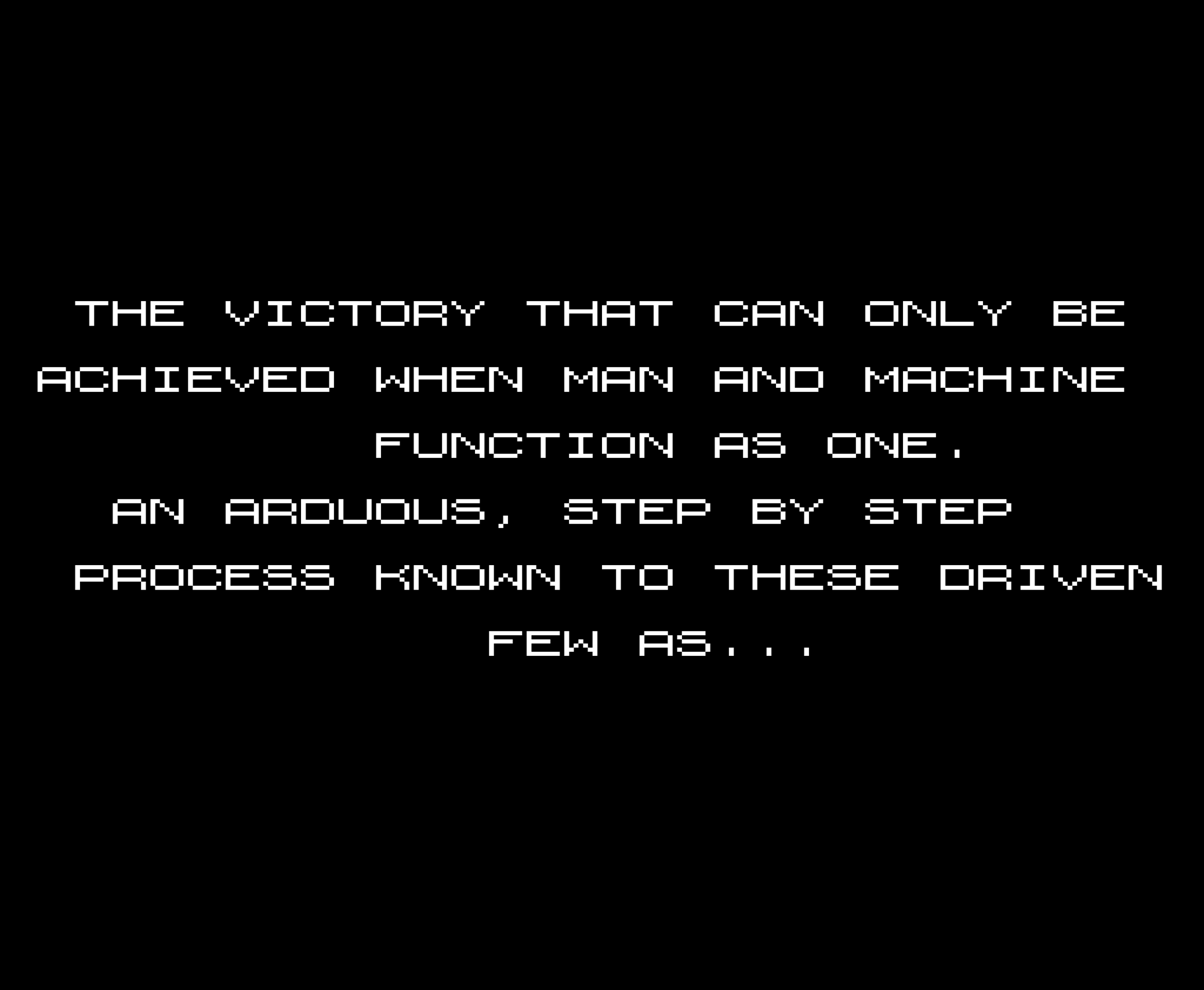
F1:BTW opens with one of the most intense introductions in any NES game, a four-screen Futurist treatise on the innate human desire for pushing achievement at any cost. I was content to putter around in my Mini Cooper, but now I’m ready to run through a brick wall.
Oddly, F1:BTW was only released in the United States. Publisher Seta’s American footprint was extremely limited: just this and a pair of punishing, clunky platformers (Adventures of Tom Sawyer and Castle of Dragon). Their Famicom catalog was a little more robust—including the original releases of 8 Eyes and Magic Darts, as well as the late-gen RPG Silva Saga—but they weren’t especially prolific until the 16- and 32-bit eras. Stranger still, developer Winky Soft—later better known for the Super Robot Taisen series—had exactly one credited racing game in their twenty-seven year history: this.
(As an aside: go ahead and laugh at their name, but note that Winky Soft had a run of PC-88 games with amazing titles: American Success, Tennis Freak, Shocking Cross Word and Mr. Winky, to name a few.)
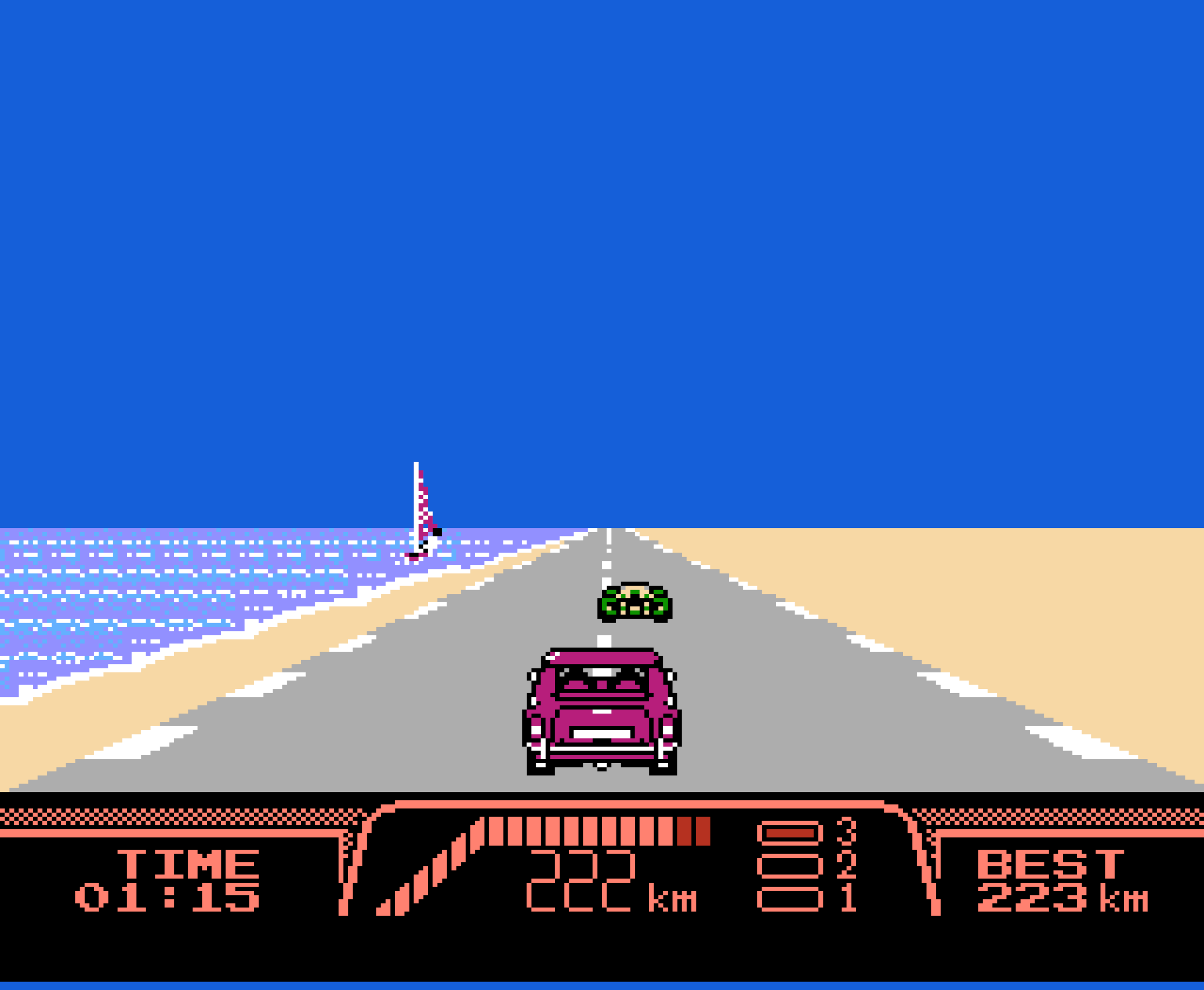
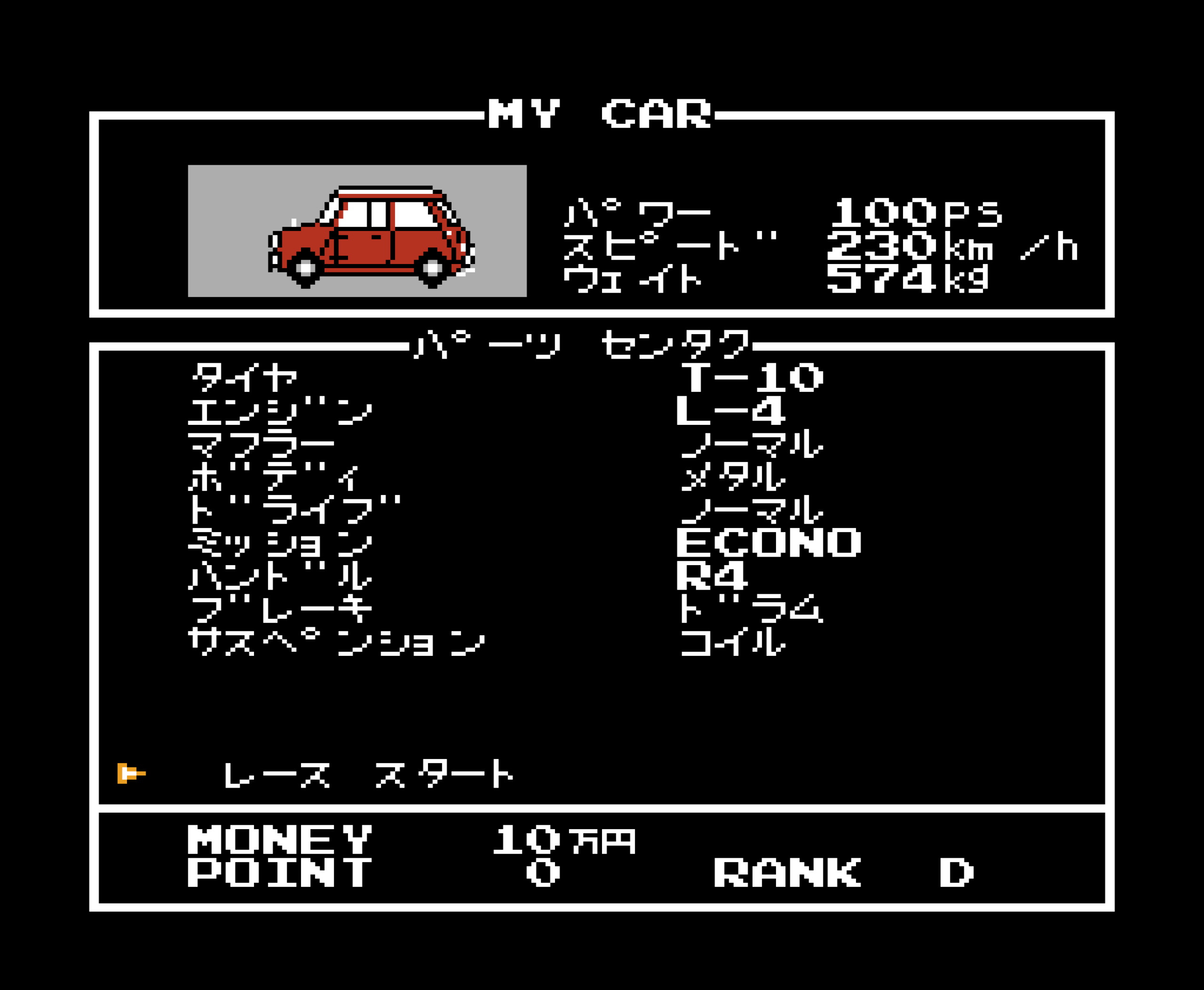
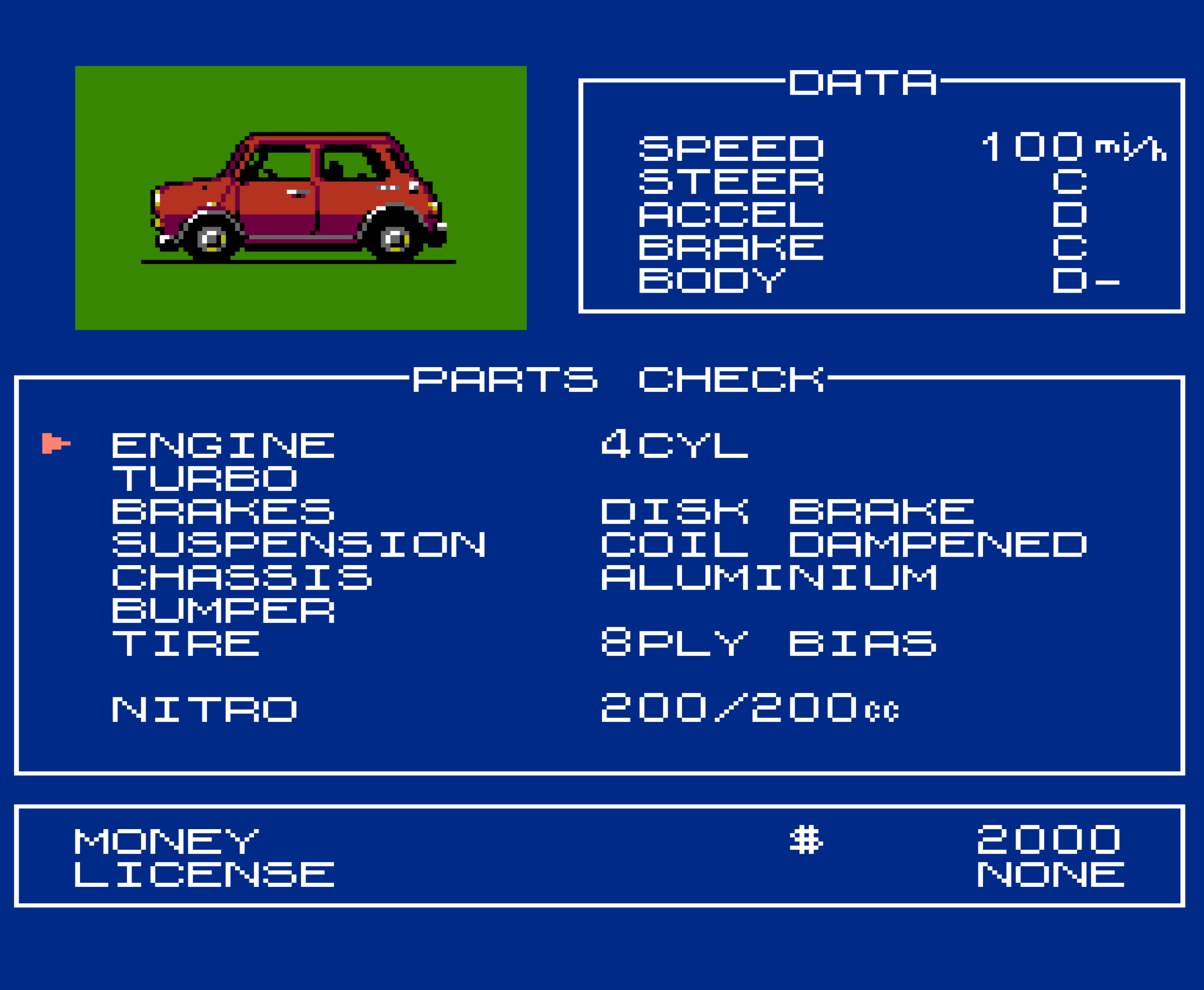
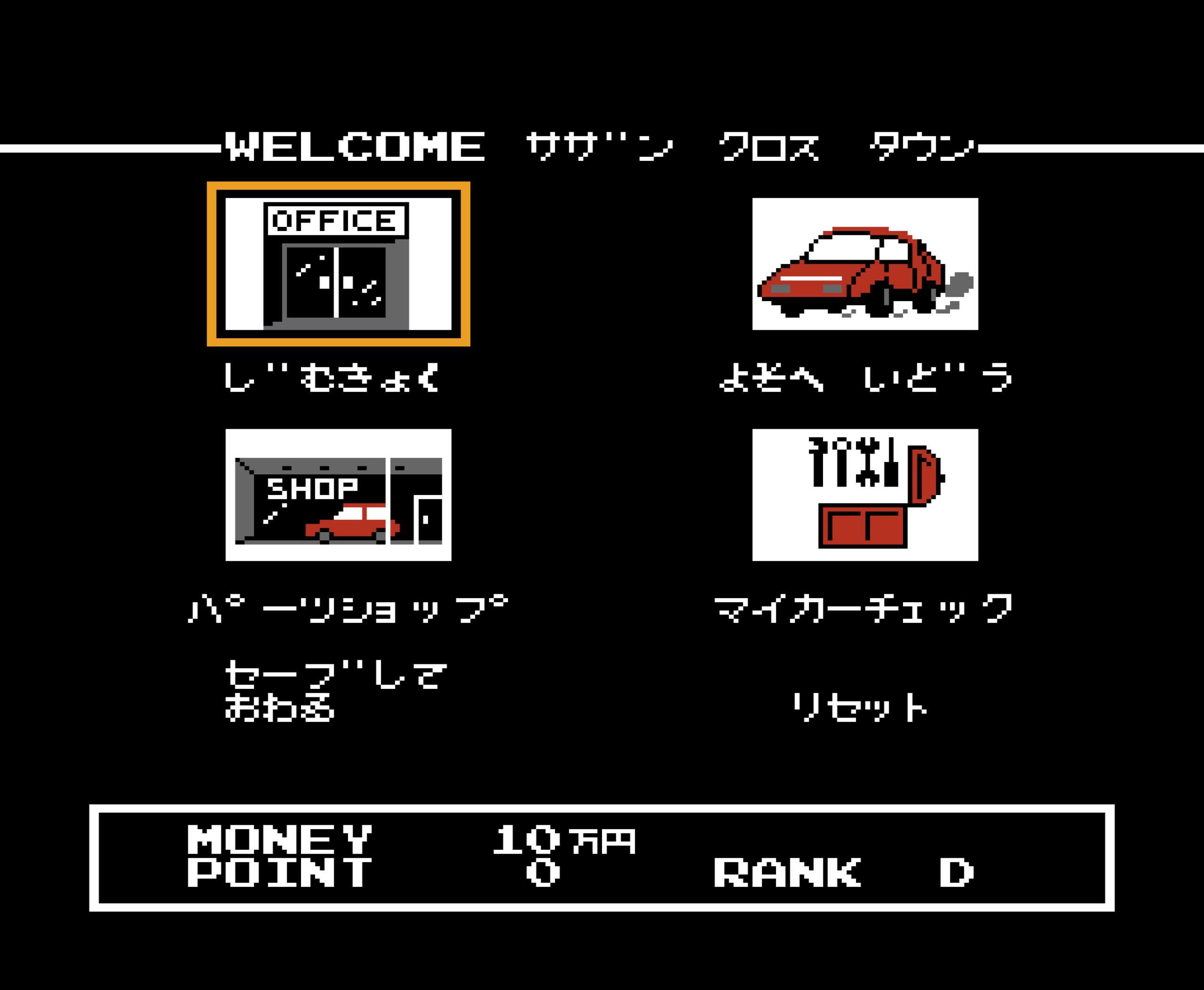
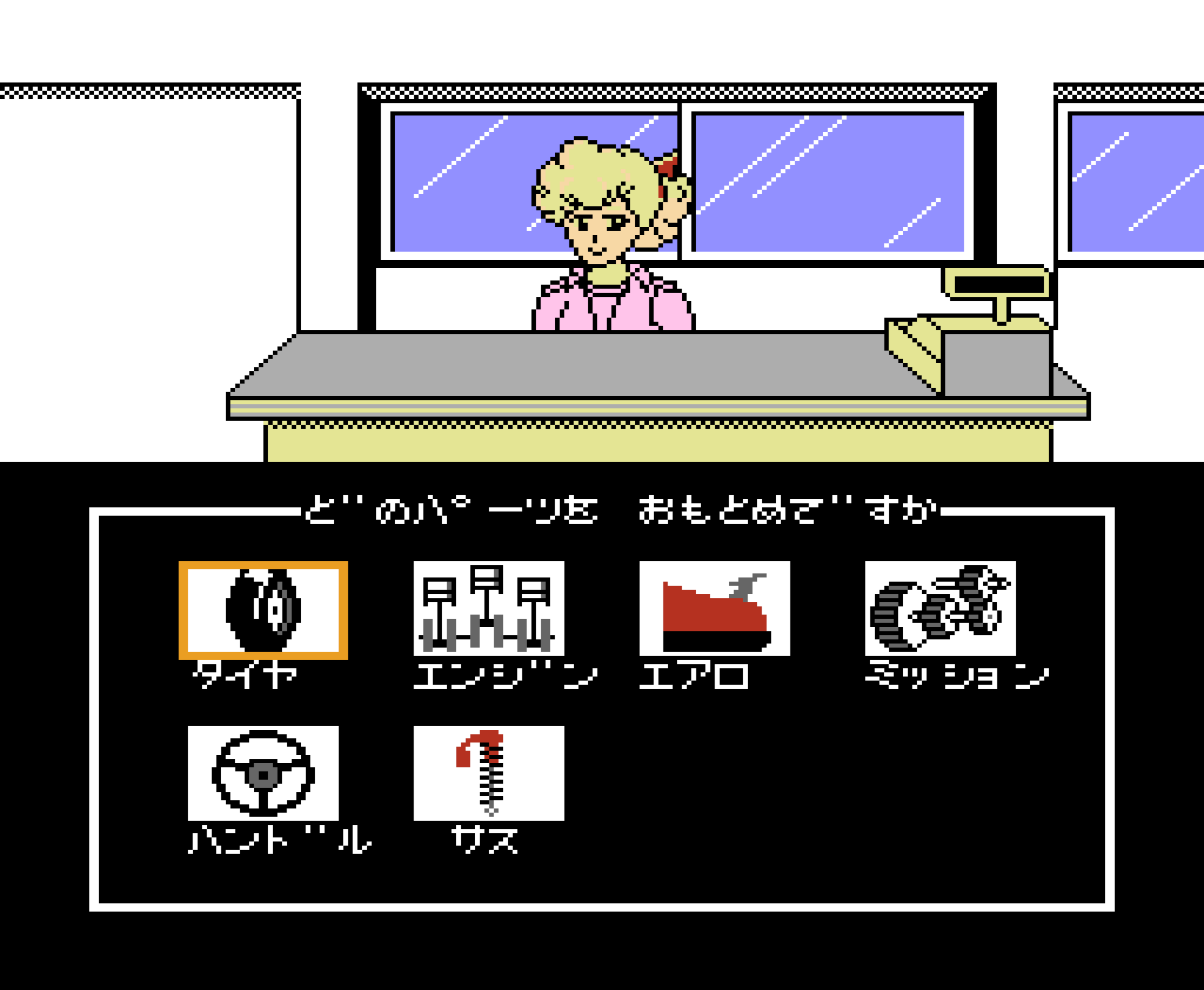
F1:BTW seemed to appear out of nowhere, but it does share a remarkable amount in common with an earlier Famicom-only release, Taito Grand Prix: Eikō e no License. Taito Grand Prix presents as a Formula-One game, but you start with a Mini Cooper, advance to a Ferrari and eventually an F1 racer. An overview map has you traveling between cities, where you can choose to buy parts, perform vehicle maintenance, or visit an office and choose one of three races, gated by a letter grade rank and an entrance fee. Some of its menus are nearly identical in presentation. Both games offer a “Normal” and “Free” mode. Both have you choose from one of three songs at the beginning of each race. You could keep going.
Mirrored Tracks
Both games feature an uncanny number of similarities, down to the profile Mini Cooper illustration. There is no official connection between the two. But, it’s fair to wonder if they were part of an intended series, or at least shared developers.
Left: Taito Grand Prix, Right: Formula One: Built to Win
Taito Grand Prix feels like it was a direct response to Sega’s Outrun, down to the palm trees and onlookers kicking off each race. It featured impressive roadside effects; the scenery could vary on each side of the track, creating a sense of location by, for example, showing a seaside on the left half and grassy terrain on the right. But Taito Grand Prix seemed like an early draft of F1:BTW, lacking its graphical detail, real-world locations and some between-race features.
Taito Grand Prix was published by—you guessed it—Taito, but it was developed by Now Production, who had no apparent connection to Winky Soft. F1:BTW has credited developers, but little is publicly available about Taito Grand Prix’s origin.
Famicom Grands Prix
Nintendo wasn’t content to let third parties have all of the misleadingly-titled fun:
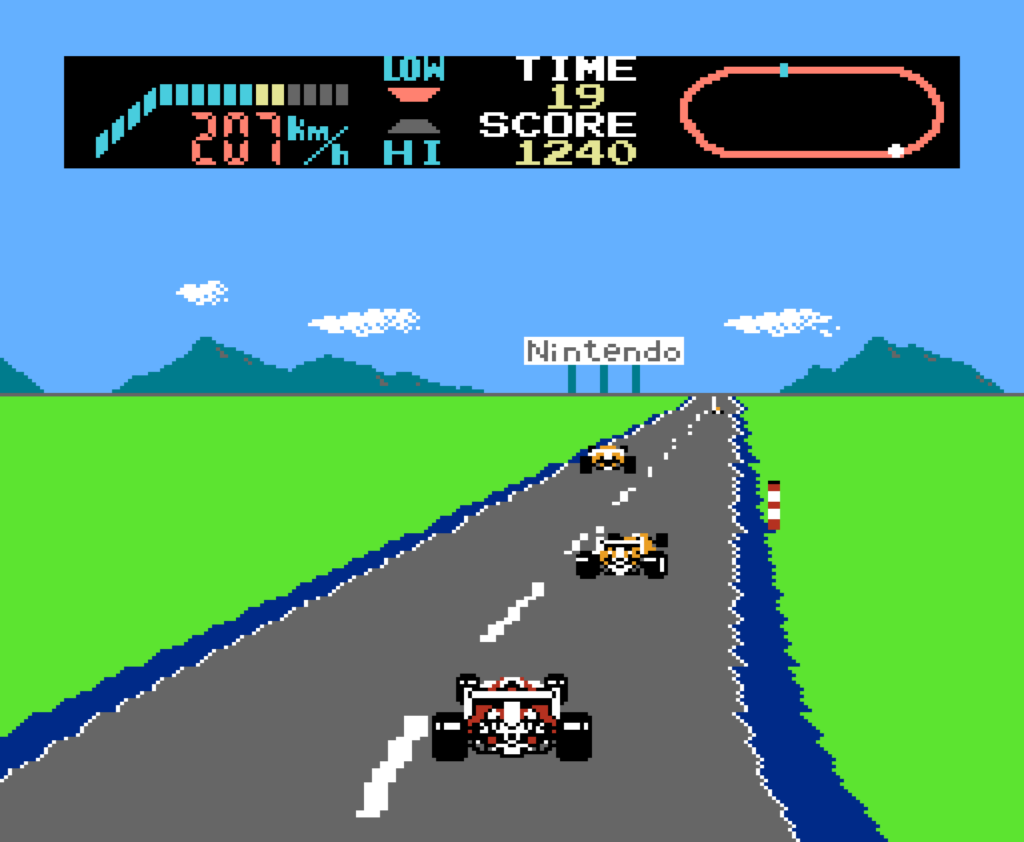
1984 saw the release of F1 Race, an early Famicom exclusive that felt like a dress rehearsal for Rad Racer a few years later. Hal’s use of a 3-D perspective was likely revolutionary for its time, at least on home consoles. (Weirdly, both games were early projects for programmers who later went on to achieve notoriety: Satoru Iwata and Final Fantasy’s Nasir Gebelli. If you want to make it in the video game industry, start by coding an F1 game.)
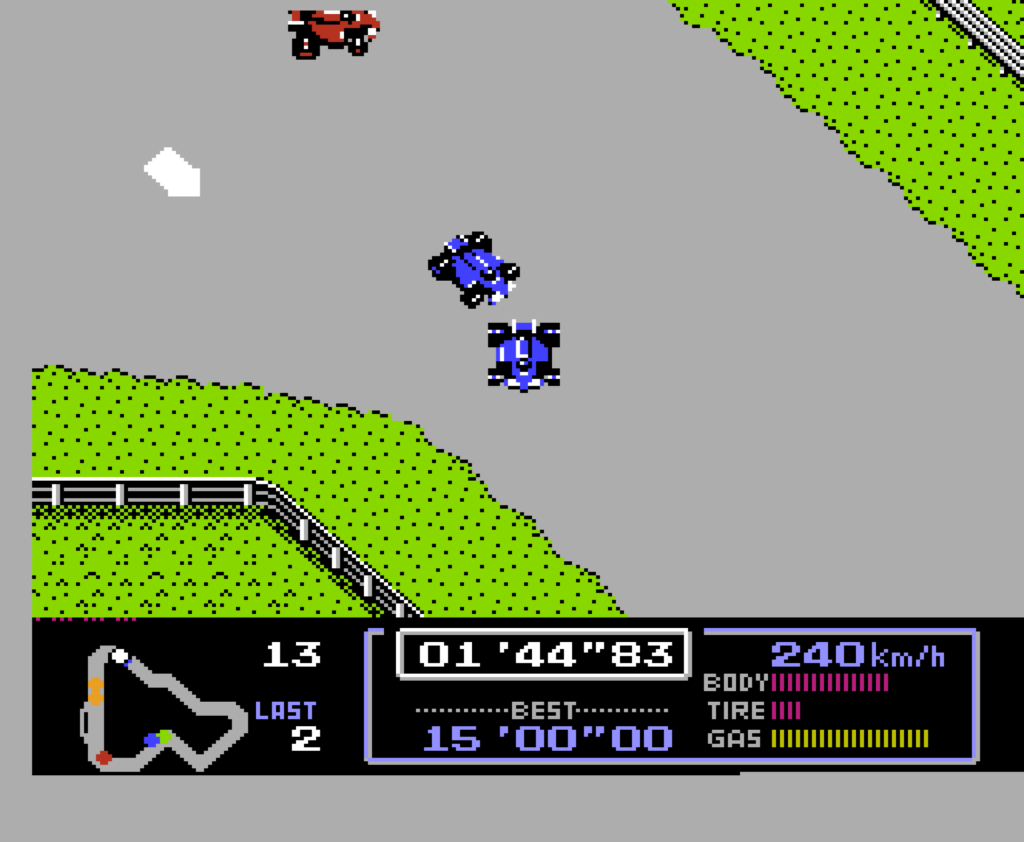
Later, the Famicom Disk System hosted the exclusive Famicom Grand Prix series, starting with the confusingly-subtitled…F1 Race. This F1 Race shifts the viewpoint overhead, resembling a version of RC Pro-AM without the weapons or (for the most part) track obstacles. It maintains some of the genre’s sim elements in between races, but it’s hampered by stiff controls.
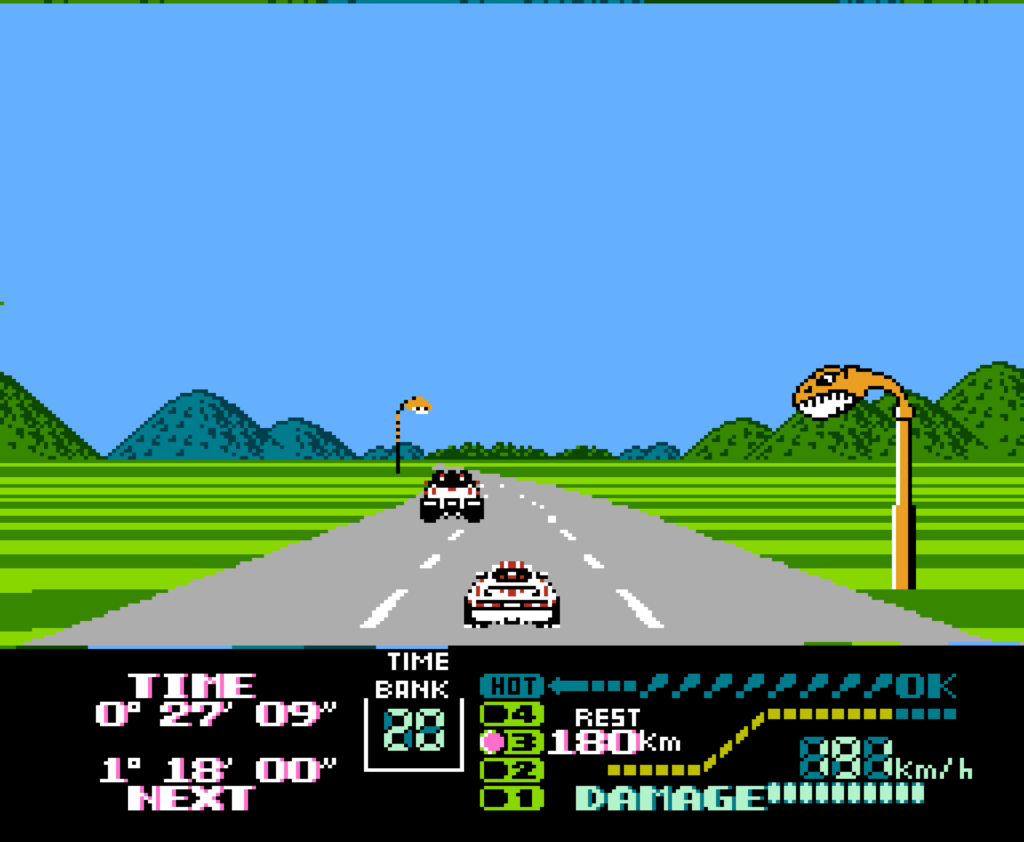
The FDS sequel Famicom Grand Prix II: 3D Hot Rally, is a forebear to F1:BTW, at least in its habit of promising a formula one game but delivering a completely different livery. Hot Rally shifts to a cross-country rally focus, with forking tracks that wander on- and off-road. It’s a wild experience with only a passing interest in realism. At times it resembles 3-D World-Runner as much as any racing game.
The GameBoy standard F-1 Race also factors in, adding up to three first-party releases within six years with essentially the same name. Also, since they’re seemingly set in the Mario universe, the Famicom Grand Prix series has the odd distinction of producing a bunch of incongruously canonical key art.
To an extent, F1:BTW feels like one of a dying breed of racing games that wasn’t pigeonholed as strictly realistic or dumb fun. A similar split occurred with sports games in the transition from the 8- to 16-bit generations. F1:BTW was released only a year after Tecmo Bowl, itself a sim/arcade hybrid that would soon be supplanted by the realism of John Madden Football.
There were some exceptions. The Super Nintendo Top Gear series maintained F1:BTW’s mix of approachable racing gameplay with realistic tinkering. But even then only briefly, with the third entry Top Gear 3000 drifting into sci-fi trappings, before reinventing itself as an off-road sim (Top Gear Rally) for the Nintendo 64. The fifth console generation brought increasingly faithful home ports of arcade racers (e.g. Ridge Racer, Cruis’n USA, and later Crazy Taxi), which tended toward a split where developers reserved customization for the realistic (and console-developed) simulations.
Decades later it’s tempting to point to F1:BTW as a precedent for career-oriented racing sims like Gran Turismo. But I think it’s closer in spirit to something like Forza Horizon, whose release in 2012 reintroduced the two diverging trends. Horizon began as a Forza Motorsport spinoff, borrowing on its realism as a base template for an open-ended experience more concerned with player-oriented exploration than mastering a set of closed tracks. Like F1:BTW it’s a game where approachable fun and simulation depth coexist. Navigating an open map for experience and equipment is vital to progress, but you’re free to tackle it at your own pace.
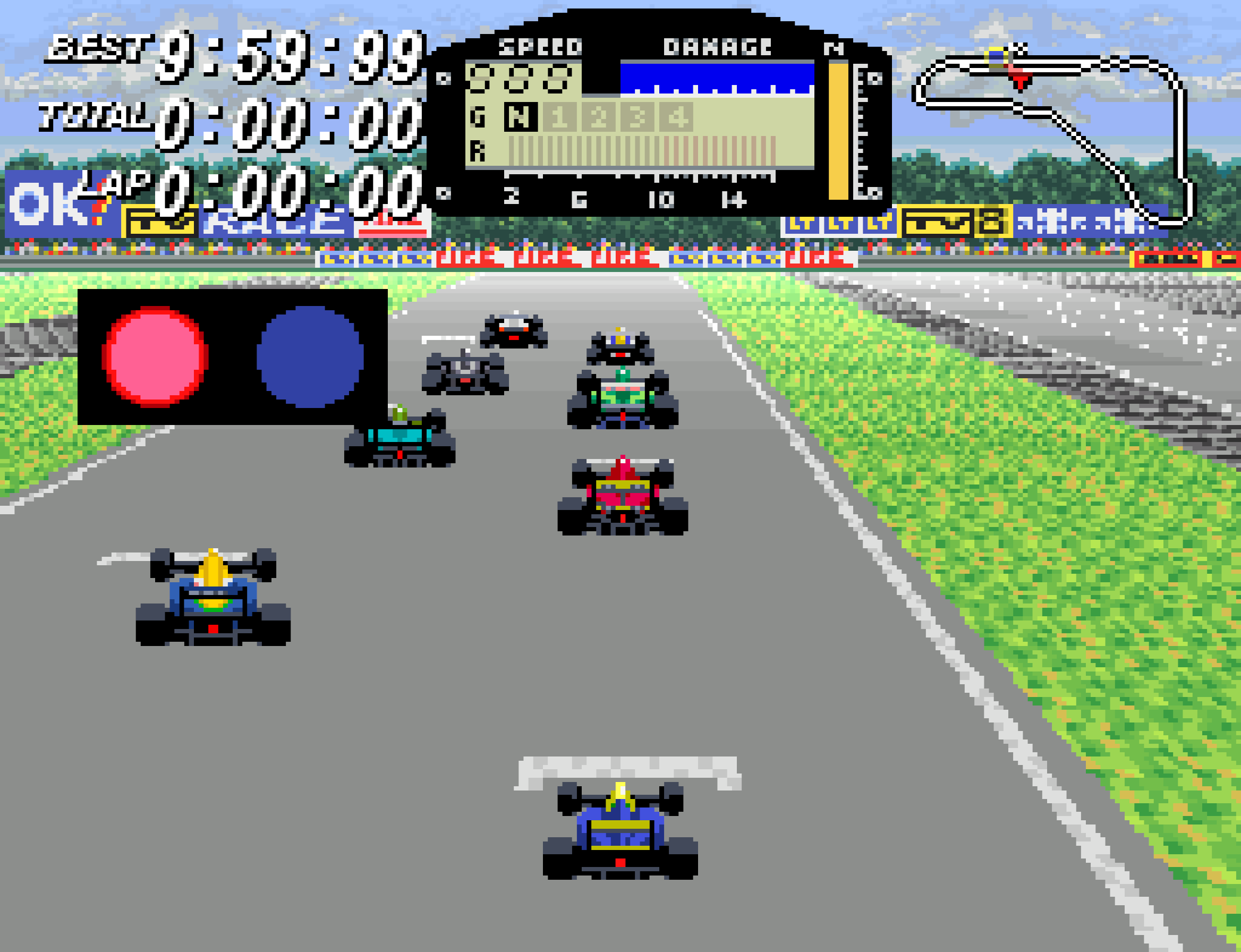
Seta’s direct follow up was the two-game F1-ROC series for the SNES. Debuting in Japan as Exhaust Heat, two years after the release of F1:BTW, the F1-ROC games maintained some of its sim elements in a Mode 7 production that looks and feels closer to F-Zero. Some of the vehicle customization options are similar, but without F1:BTW’s ambitious idiosyncrasies, the unofficial follow-ups lose some of its charm. (After all, what good is a suspension upgrade if it’s not sold by an anime lady in a Denver parts shop?)
Winky Soft and F1:BTW’s development team were not involved with F1-ROC’s production, other than producer Tōru Ishikawa, who was credited in a sales role for both. By this point they had mostly moved on to the early games in the Super Robot Taisen series, which they would largely produce until their bankruptcy in 2016.
Even if it was mostly forgotten—or simply overlooked by fans for all of these years—F1:BTW’s legacy was honored by F1-ROC. The American box art proudly proclaims it’s “BUILT TO WIN.”
