


Unreleased Hockey Role Playing Games
1993 Nearly Marked the Advent of an Unlikely Genre Experiment: the HRPG.
Despite whatever preconceptions you may have about their audiences, there has long been a connection, if uneasy, between sports and role playing games. Typically—if you are willing to indulge the oversimplification—they are based on abstractions of warfare. (The difference between a die roll and a touchdown pass is significant, sure, but they are a distillation of the base elements of combat: territory conquered, enemies defeated by physical dominance, local, regional and national pride, and so on.) Both are heavily stats-driven, leading dedicated fans and players to scour for inefficiencies in the underlying math. Both augment their quantitative side with a storytelling layer, using the data in service of narratives of player and character advancement. Both fanbases love cosplay.
Today, fantasy sports are an entrenched marriage of the two, accounting for a multi-billion dollar industry with an estimated reach in the tens of millions. However there has long been some common ground; early sports/game adaptations go back centuries. Writing for The National Baseball Hall of Fame, Rick Burton notes several baseball board and card games dating back to the early 1900s, including “cards, dice, spinners, die-cut stadiums and miniature paper figurines meant to represent in-the-field players or base runners.” (Burton also cites early home versions involving pinball flippers dating back to the 1860s, not far removed from the advent of the sport itself.) Games that began to incorporate actual player stats followed, including 1930’s National Pastime, a board game featuring cards based on real players. Rotisserie Baseball—the direct predecessor to modern fantasy sports, using box scores as data points—was established in the early 1980s.
For video games, both sides of the divide (sports and RPGs, nerd games and jock games) also began to find some common ground. Modern day sports games now offer modes that are functionally role playing games, part of a larger trend in game development to add depth to action-oriented games using traditional RPG mechanics: experience points, skill trees, buffs and debuffs, etc.
But even in the NES days the distinction was starting to blur. While launch-era Baseball was an action-forward distillation of the sport’s basics, a few years later games like Major League Baseball and Bases Loaded would introduce player stats and roster management. Other sports saw similar evolutions. Tecmo in particular pushed the boundaries with its league sports sims such as basketball (Tecmo NBA Basketball) and football (Tecmo Bowl, Tecmo Super Bowl), incorporating real players with personalized stats.
Hockey games on the NES, though, seemed to follow a different trajectory. The games best regarded either used national teams (Nintendo’s Ice Hockey), or made-up teams (Blades of Steel). While there were later games that attempted to incorporate NHL players, and a little more simulation depth, they were largely forgotten. The defining hockey games for the system tended to embrace an elemental, arcadey simplicity.
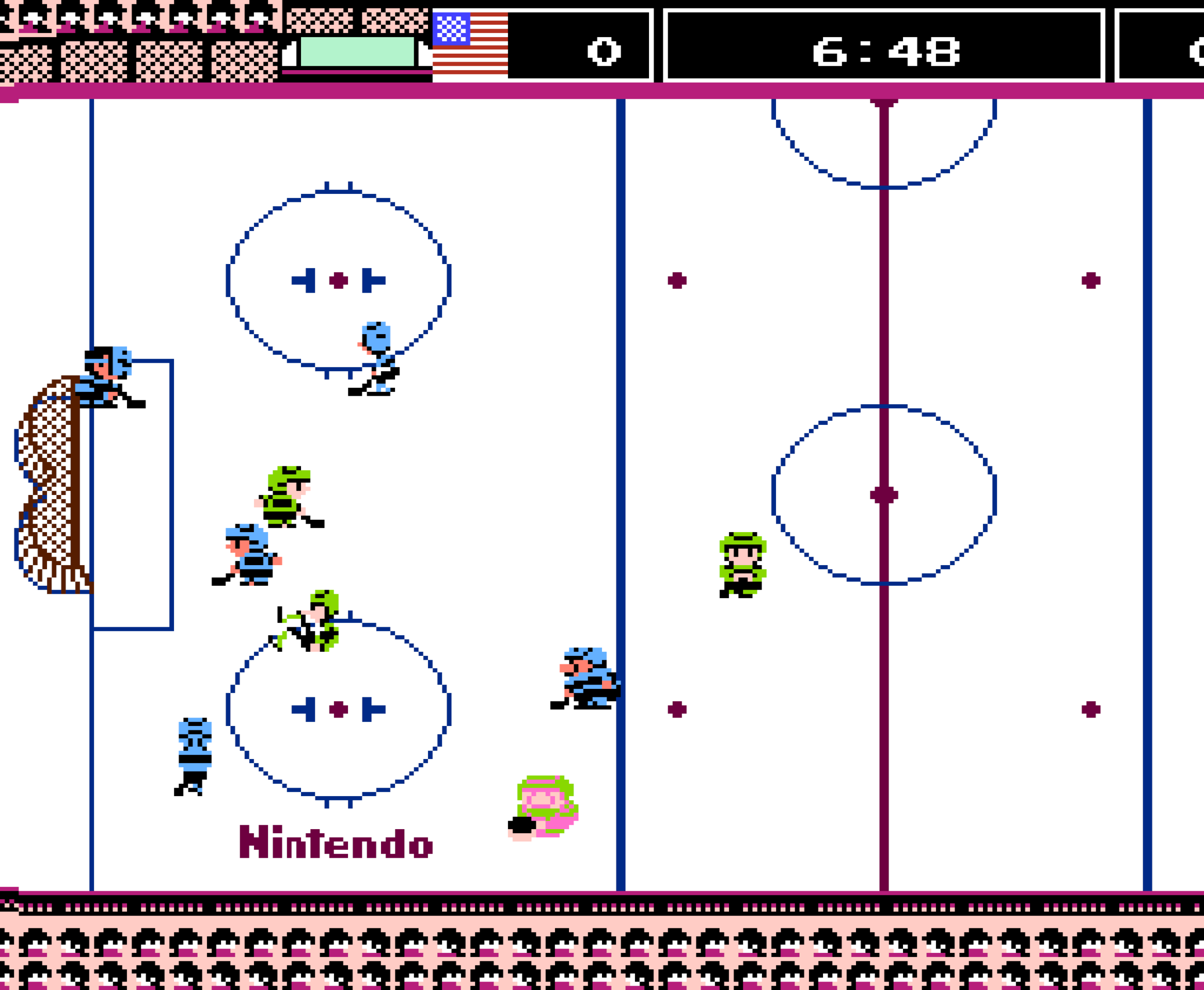
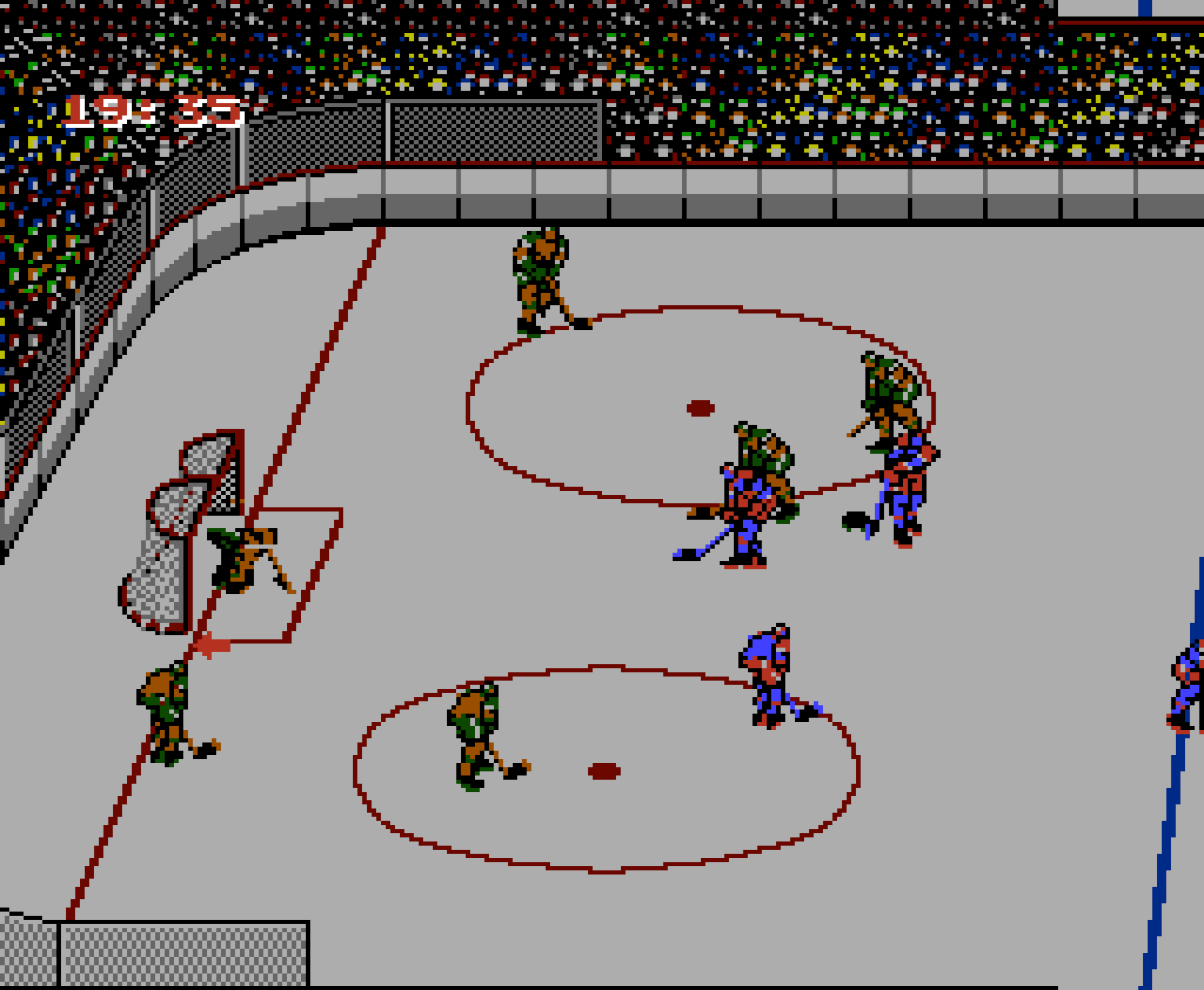
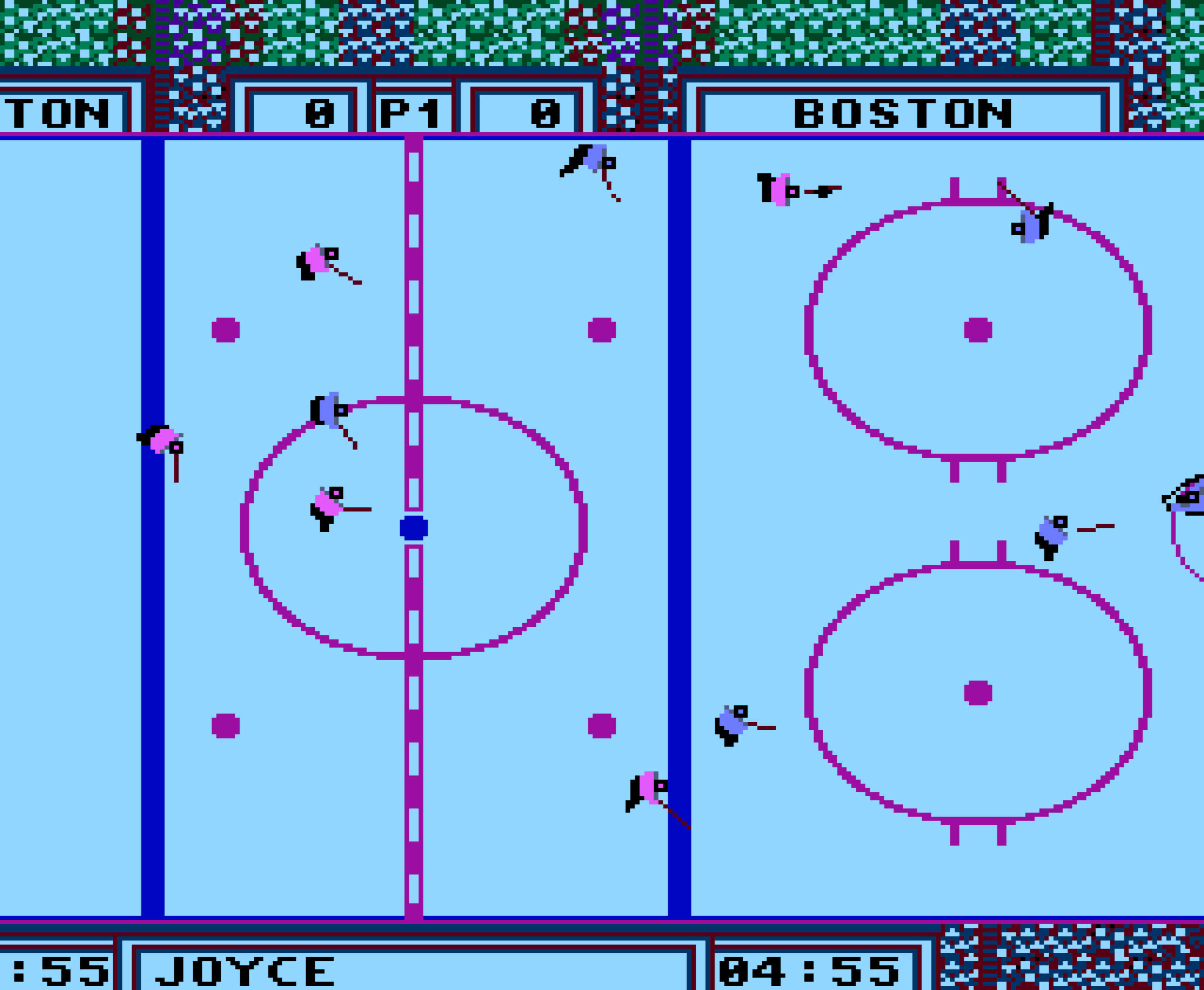
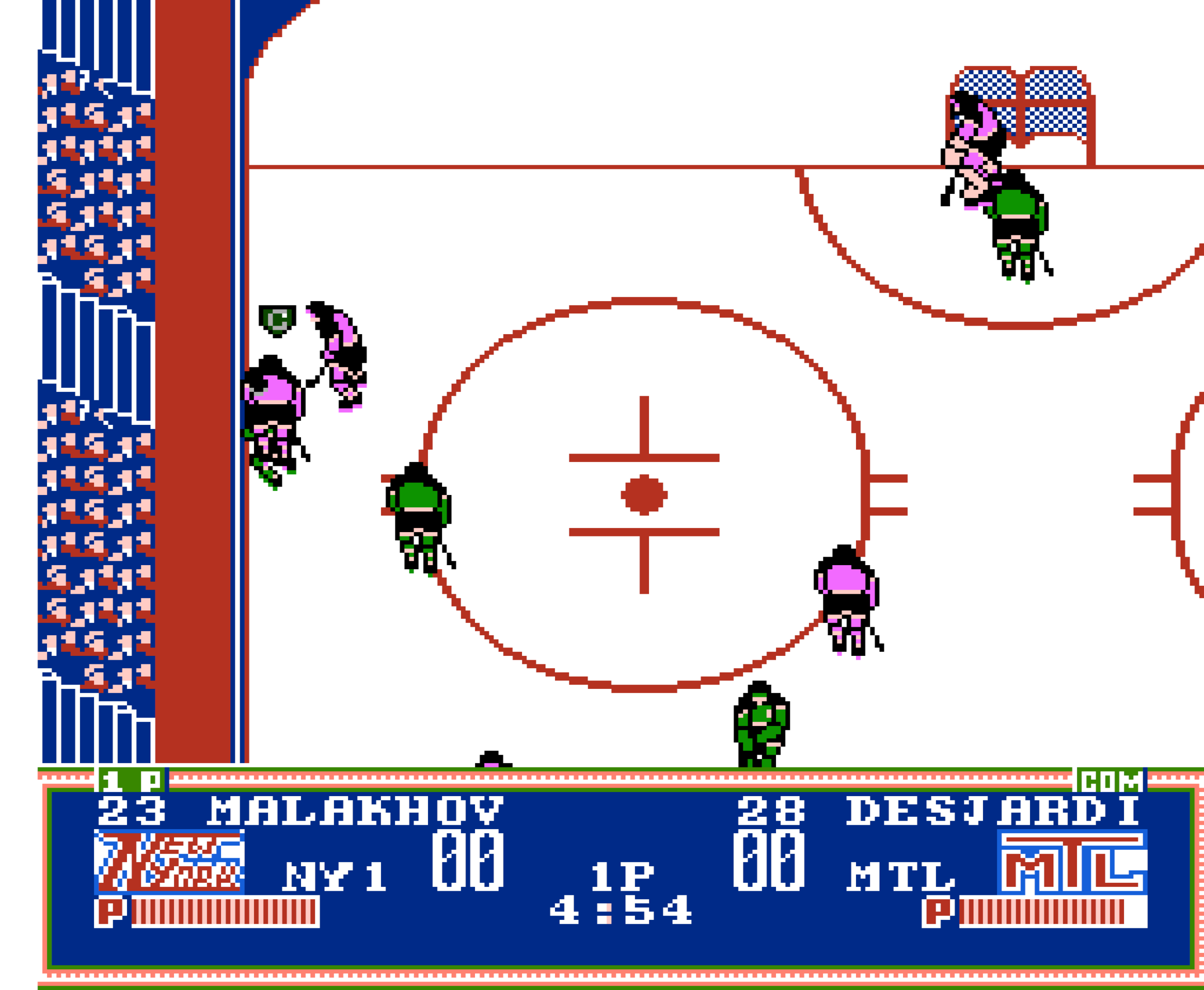
Why that is the case probably involves a larger set of questions about the geography of game development in the NES era, hockey’s lesser status among North America’s major sports leagues and the animated nature of the sport itself. Perhaps there’s an inherent slapstick to a sport full of collisions, falling and fighting that caught the attention of the period’s developers. These elements would translate to early video game hardware better than, say, the intricacies of line changes and power play rotation.
It’s interesting that as the NES aged, and advanced cartridge technology allowed for deeper gameplay systems, hockey game developers weren’t uniformly pushing for more accurate simulations of the real game. Instead, there was a brief moment where this heightened, comic understanding of the sport served as the basis for games with deeper, but seemingly mismatched, genre hallmarks. In 1993 a pair of unrelated (and ultimately unreleased) games prepared to combine arcade hockey with classic RPG mechanics: Crash ‘n’ the Boys Ice Challenge and Hit the Ice.
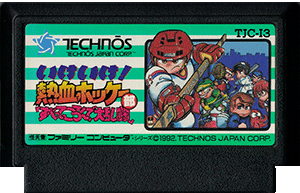
Crash ‘n’ the Boys Ice Challenge
Release date: 1993 (unreleased)
Developer/Publisher: Technos
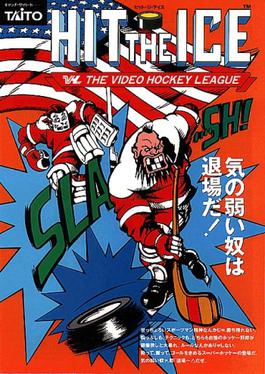
Hit the Ice
Release date: 1993 (unreleased)
Developer/Publisher: Taito

Crash ‘n’ the Boys: Ice Challenge
The Kunio-kun series has a long history in Japan, only sporadically appearing in the West with a variety of titles and publishers. It’s centered on high school student Kunio, a greaser-era throwback who has a penchant for beating the shit out of people. The series began with the Arcade brawler Nekketsu Kōha Kunio-kun, later ported to the Famicom and localized for the NES as Renegade. It took an immediate swerve with Nekketsu Kōkō Dodgeball Bu, a dodgeball tournament sim translated as Super Dodge Ball, then building on Renegade’s rough draft with Downtown Nekketsu Monogatari, known elsewhere as River City Ransom or Street Gangs.
These two games set the template for most of the series: either Kunio was wronged in some way (often a kidnapped girlfriend) and was tasked with brawling his way through a series of teen gangs, or he is the cornerstone of one of Nekketsu High School’s many varsity sports. After Super Dodge Ball most of the series used River City Ransom as a foundation, both in terms of aesthetics and gameplay. Regardless of the sport, many of the later games maintained River City’s Ransom’s fighting mechanics.
The Famicom had about seven of these Kunio sports games, including everything from dodgeball to basketball, track and field, and soccer (twice). A few of these games never made it out of Japan. The excellent Nekketsu! Street Basket: Ganbare Dunk Heroes is an insane reimagining of basketball with melee weapons and three hoops stacked on top of each other, while Downtown Nekketsu Kōshinkyoku: Soreyuke Daiundōkai remixes River City Ransom into a linear footrace, something like parkour with more assault and some light breaking and entering. The ones that did make it over were scattered between publishers in a way that suggested no shared history. Super Dodge Ball was published by Sony Imagesoft and Nintendo World Cup (Nekketsu Kōkō Dodgeball Bu: Soccer Hen) was a first-party release.
River City Ransom’s US publisher, American Technos, later released the track and field entry Bikkuri Nekketsu Shin Kiroku! Harukanaru Kin Medal as Crash ‘n’ the Boys: Street Challenge in 1992. This appeared to be their attempt at brand consolidation for the Western audience, as the Kunio hockey game Ike Ike! Nekketsu Hockey Bu: Subette Koronde Dairantō was announced as Crash ‘n’ the Boys: Ice Challenge for release in May 1993. Electronic Gaming Monthly and Nintendo Power both ran previews with images of an English localization, EGM calling it, “One of the best NES hockey games ever!” while Nintendo Power dismissed it as “simplified” and “not very challenging.” All the same, Ice Challenge’s release appeared certain. EGM’s preview claimed it was “99%” complete.
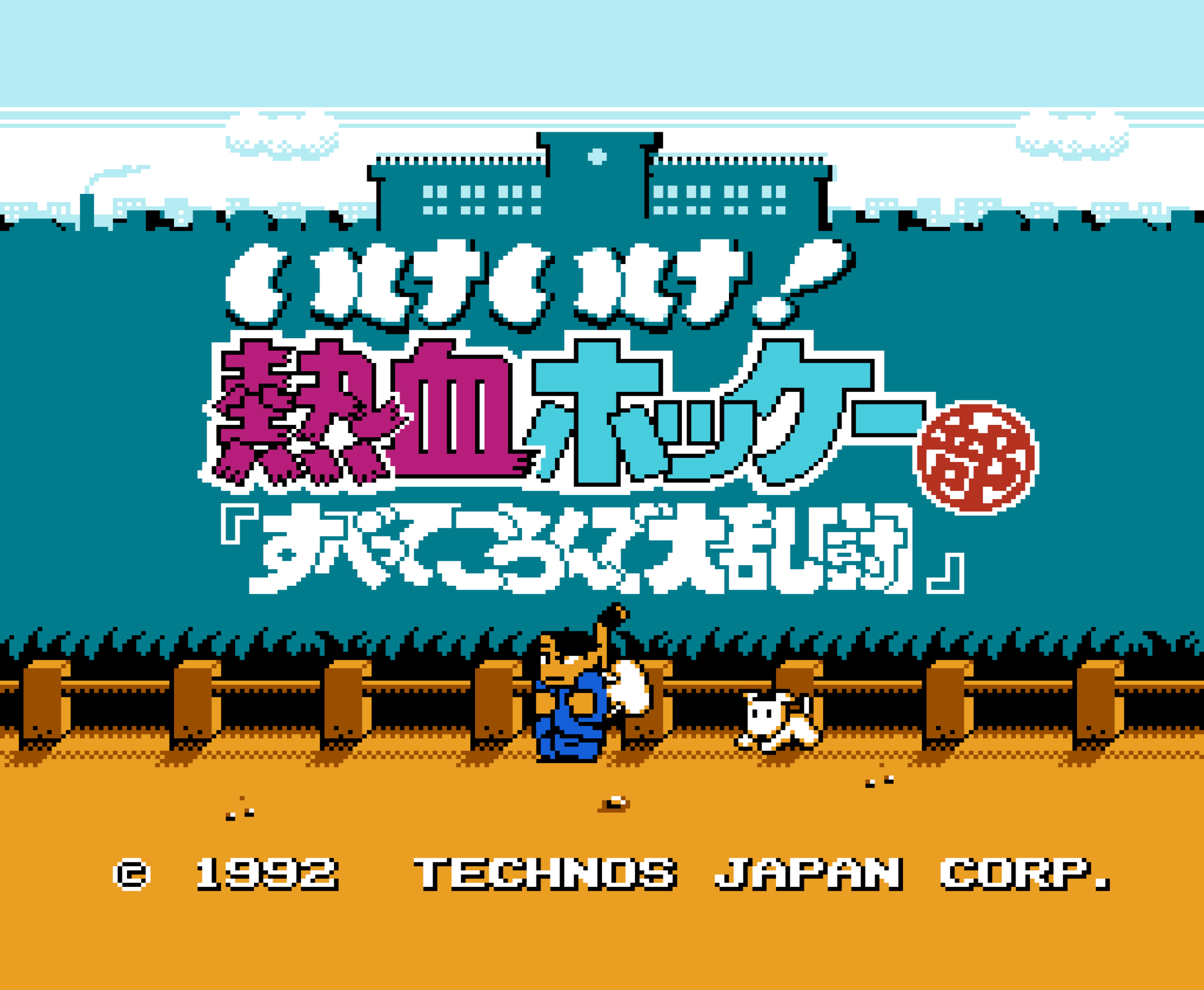
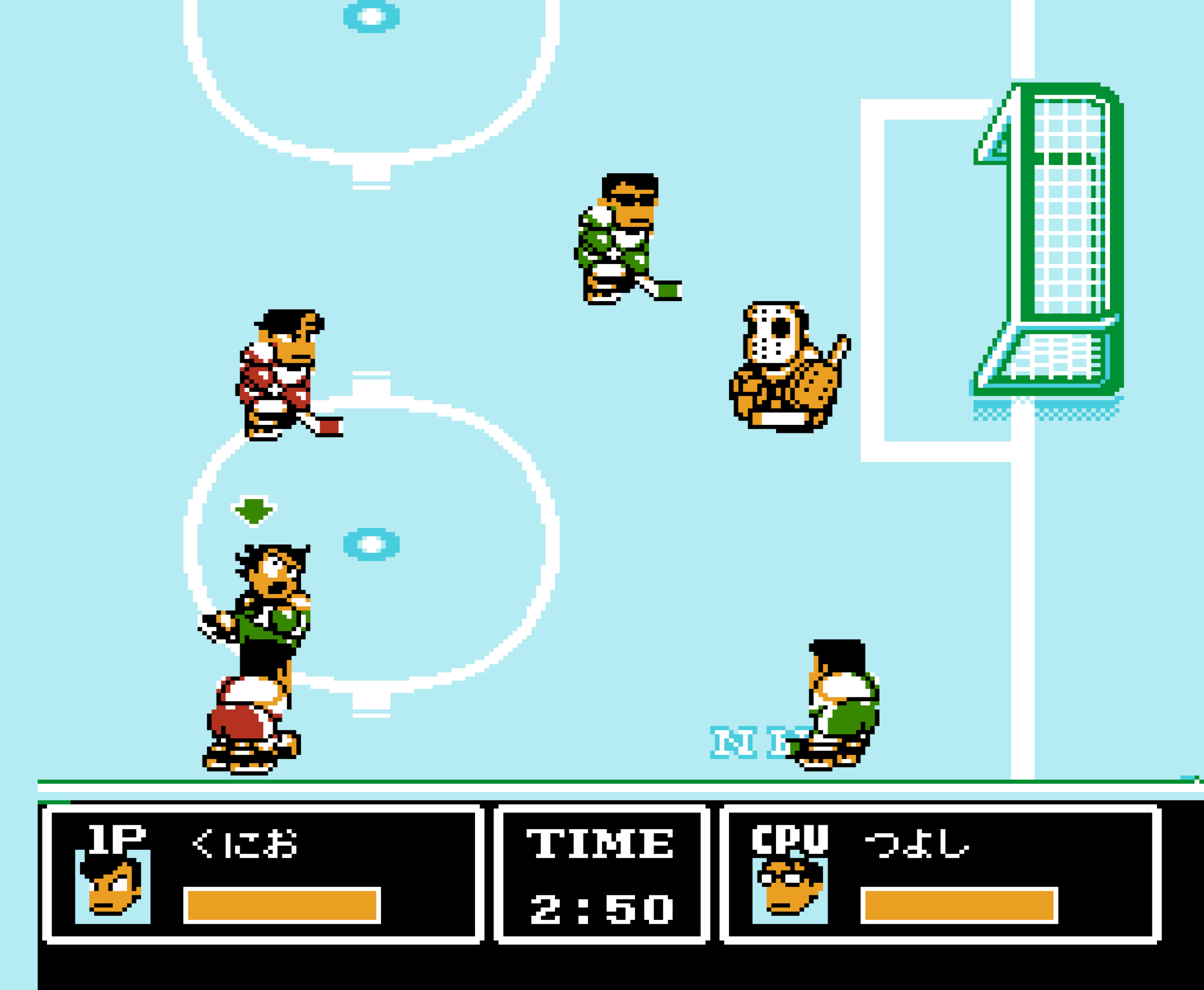
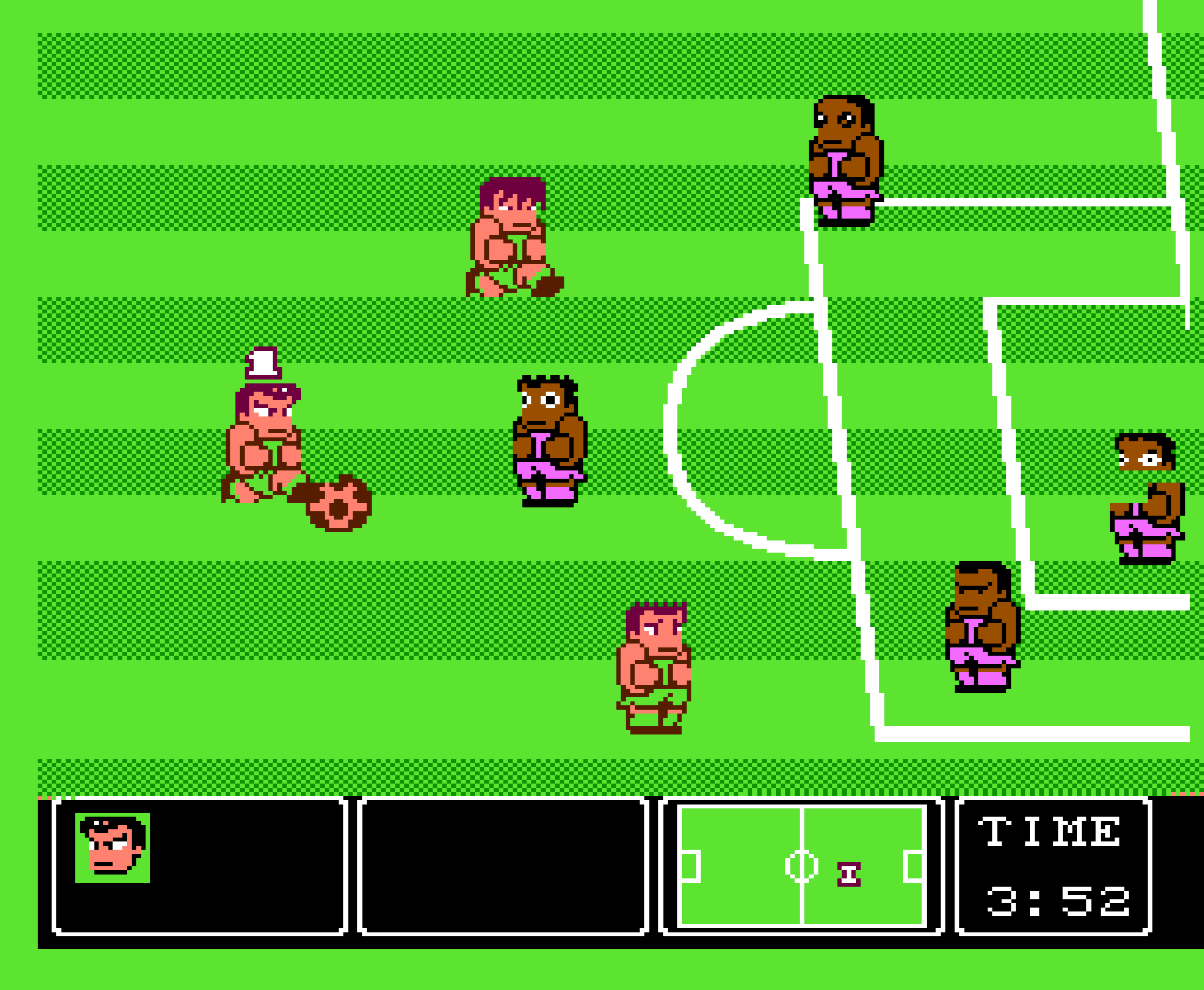
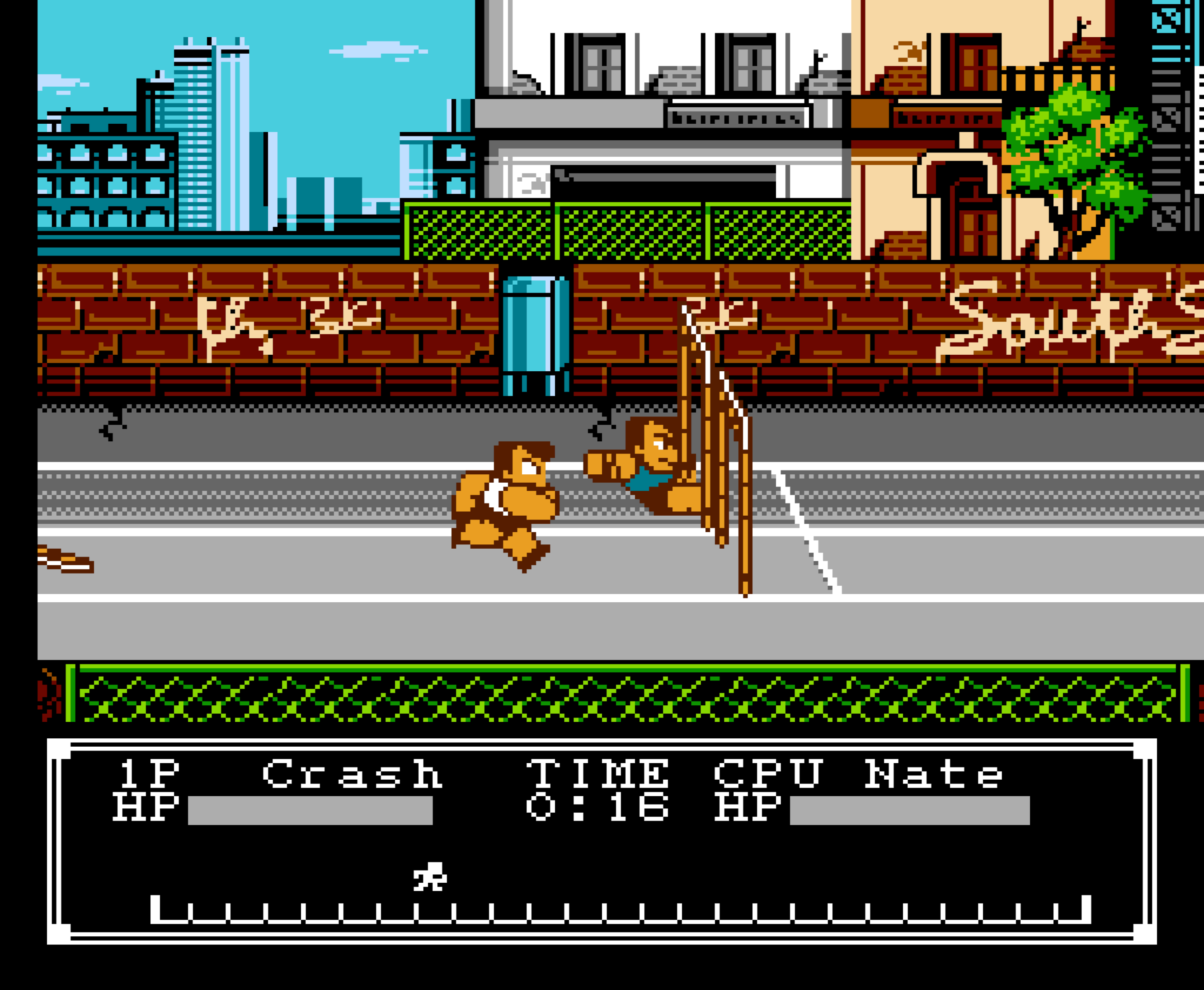
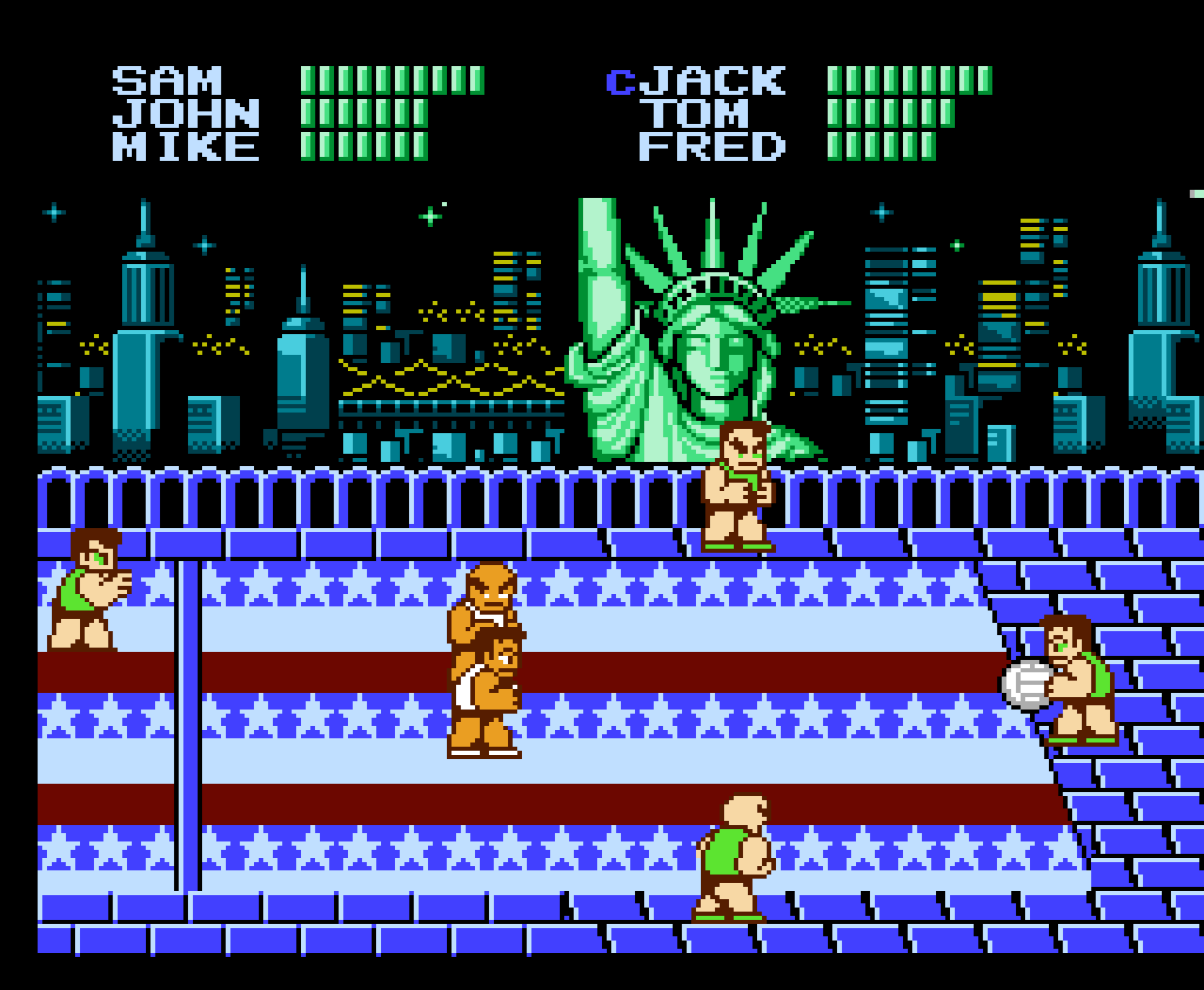
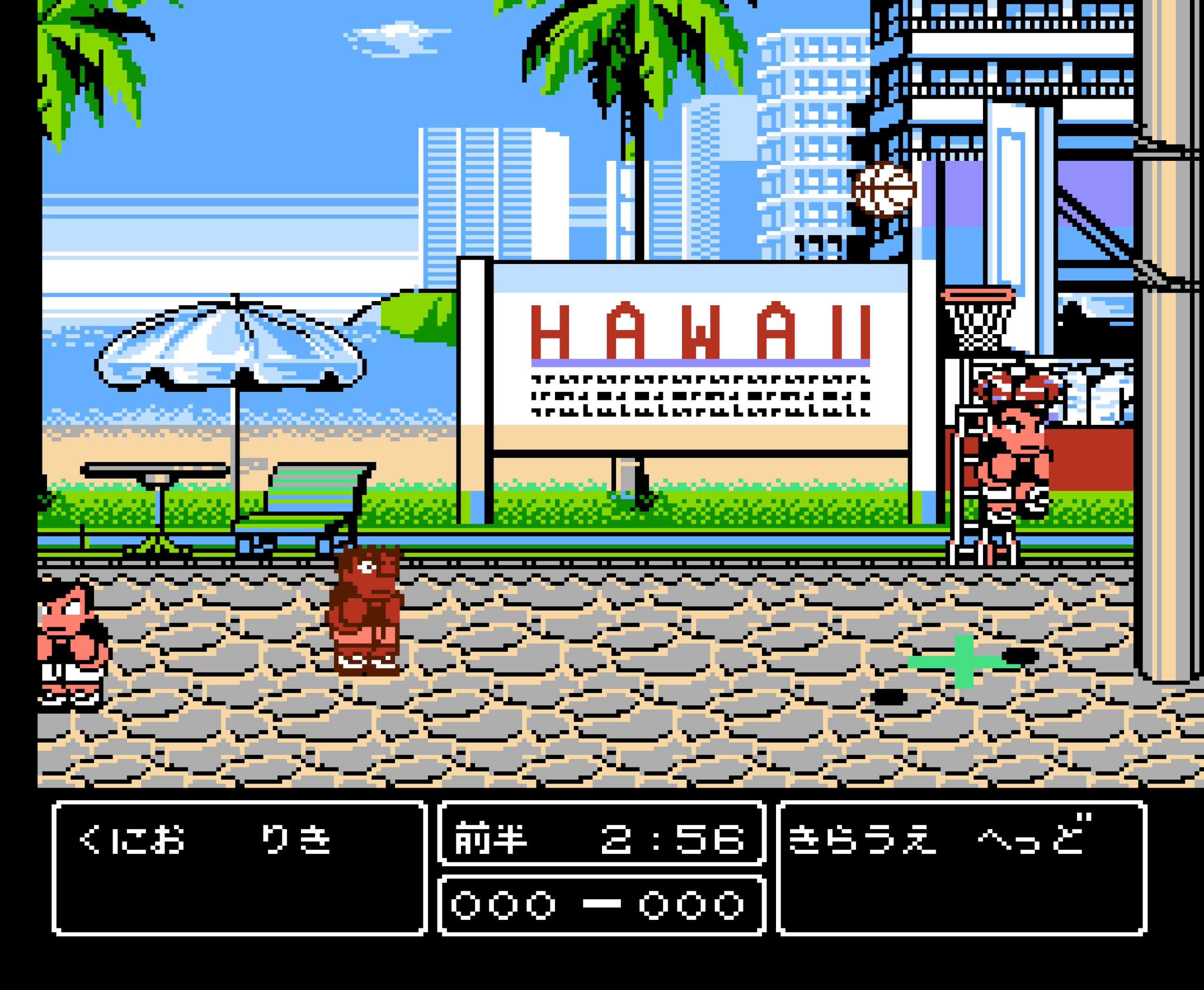

Crash ‘n’ the Boys Everything Challenge
The Kunio-kun crew competed in a wide variety of varsity sports, from left to right: soccer, track and field, dodgeball, basketball and…unsanctioned cross country.
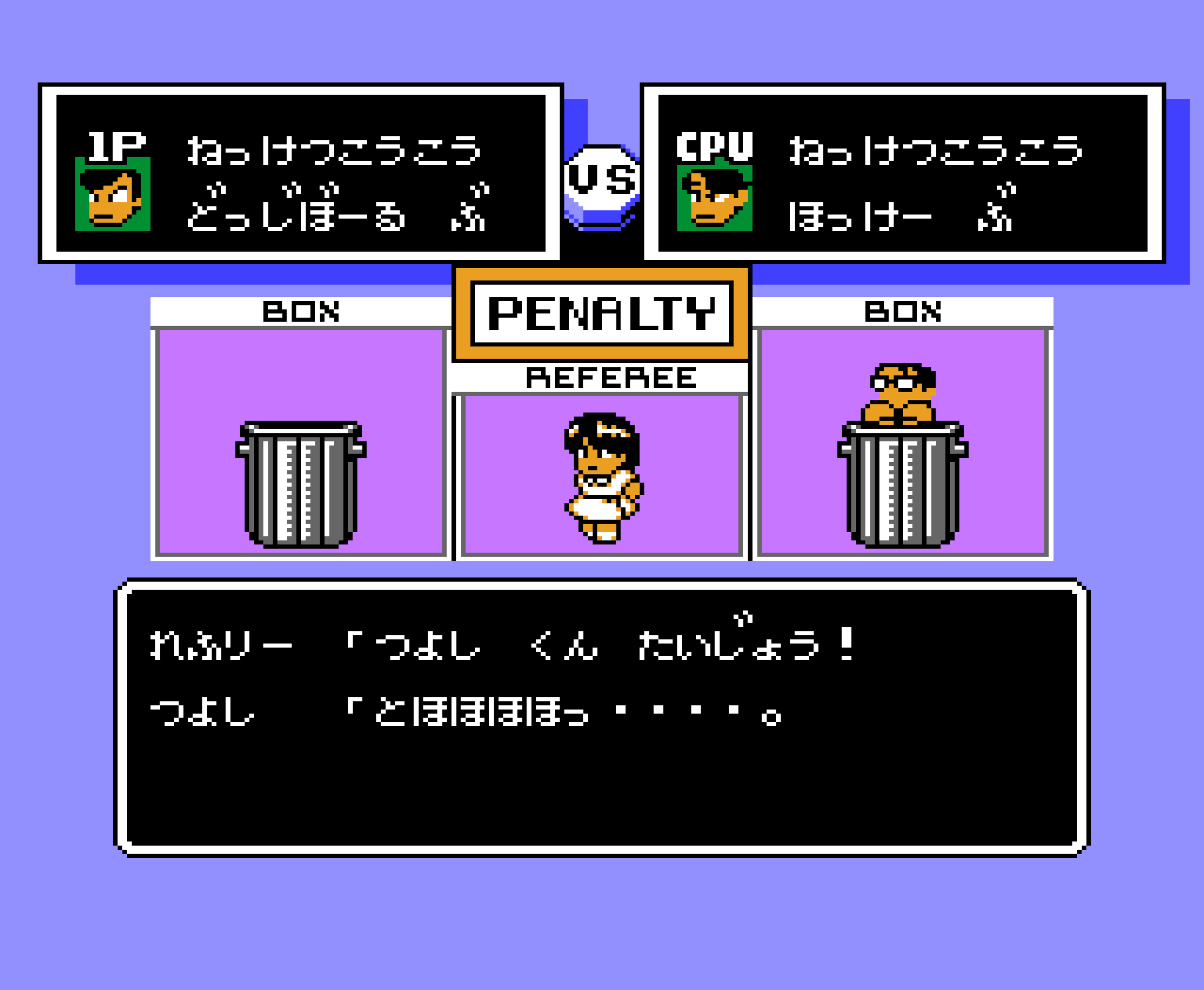
Ike Ike! Nekketsu Hockey Bu: Subette Koronde Dairantō gets mangled by machine translation, but it’s something in the spirit of Go Go! Hot-blooded Hockey Club: Slip and Slide Brawl. (As a rule, Famicom games always had the better titles.) It has a versus mode that supports up to four players, but the default is a story mode that sees Kunio-kun—fresh off of his success with the dodgeball club—approached by a member of Nekketsu High School’s crappy hockey team. They are desperate for his help. A quick scrimmage proves their point; after breezing through a tutorial match, the game’s story mode begins. Kunio’s team takes on a series of rival clubs who are defined by non-hockey pursuits: kendo, cheerleading, baseball, American football, and so on.
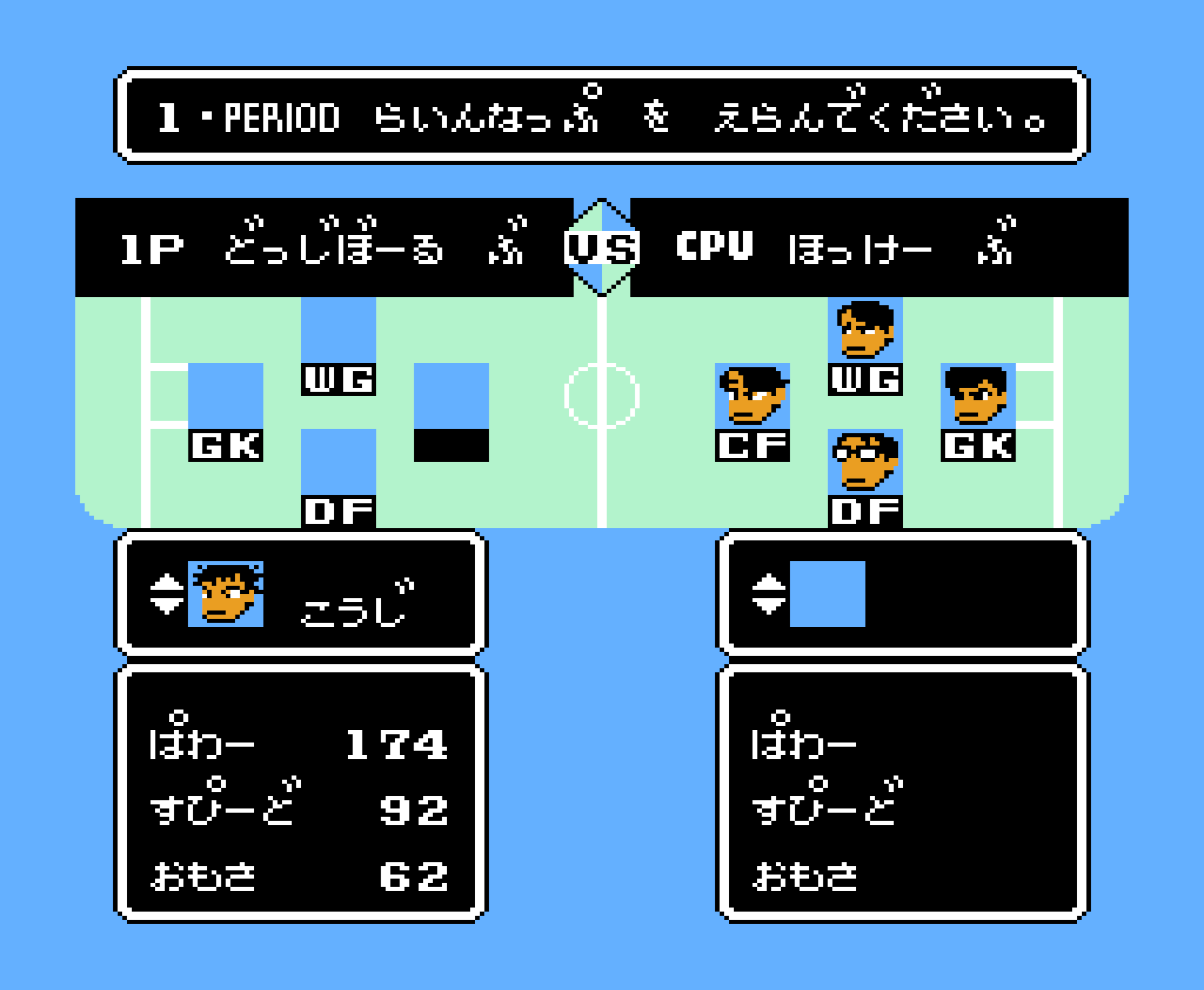
After defeating each club, Kunio’s team gains access to their uniforms. Switching equipment between games affects your baseline stats; each uniform has its own unique attack and defense numbers, as well as a special move that can be performed by attacking in the middle of a jump.
That’s right—jump. Ike Ike! Nekketsu Hockey Bu: Subette Koronde Dairantō (or for the sake of brevity, Ice Challenge) is built upon River City Ransom’s foundation. The controls are similar: B and A together jumps (while in the air, A swings your stick, B performs the special move). On defense both A and B check, although checking in this game is more like a two-handed slash, carried over from River City Ransom’s pipes and baseball bats.
Offense is a little trickier, and is—other than the mid-air special attacks—what separates Ice Challenge’s on-ice action from other hockey games. B is a standard shot. Hold it long enough and your stick will start to flash, powering up a slap shot that can bowl through opponents. The A button, rather than a conventional pass, sort of flips the puck in the air a short distance. Players can use this move to avoid defenses, but the game invites you to flip the puck up, jump, then time a shot from mid air—sort of a one-man one timer. In theory you could use the A button to attempt to dump and chase, but Ice Challenge has its own logic that is resistant to actual hockey strategy. (Though if you’re really dedicated, you could use this move to attempt something akin to the Michigan.)
This would be enough for an endearing game—an offbeat but inventive take on the sport that has little interest in realism—but Ice Challenge wants you to consider the numbers underpinning all of this. Each team has five players and four roster spots (a simplified line of center, wing and defenseman, plus a goalie). Every character in the game has a unique name, appearance and set of stats, including HP, power and speed. The story mode’s difficulty is on a sharp curve, and in order to keep winning you’ll need to be wary of how you manage these assets. Lines have to be set and reconfigured before each period, and it’s a balancing act to determine if a character’s high HP, for example, would be better suited for offense or defense. In-game players will begin to wear down if they take too much abuse, so it’s vital to keep their lines rotated. The uniform system provides one more layer of strategy, adding stat boosts and special move efficiency as considerations.
OK fine—is any of this really a role playing game? Maybe I’m stretching the term a bit. It wasn’t uncommon to find NES sports games with roster management (especially baseball sims). The hockey games we did get were almost exclusively action-oriented. Compared to something like Ice Hockey or Blades of Steel, the mere presence of player stats makes this feel like Wizardry.
I think that Ice Challenge sits in something of a gray area, not unlike the Be a Pro modes in modern sports games. There are plenty of what get classified, nowadays, as RPG elements: named characters with unique stats; a focus on how those characters are positioned in action; equipment management; an overarching story told through between-mission cutscenes; etc. The game has hit points. While it lacks the overworld map and item shopping you would associate with a classic console RPG, the segmented ‘combat’ and roster management screens—with a pause to place characters in position according to their abilities—start to resemble the nascent Tactical RPG genre. Fire Emblem’s Famicom debut predated Ike Ike! by only two years.
(It’s worth noting that Ice Challenge’s aforementioned basketball successor, Nekketsu! Street Basket: Ganbare Dunk Heroes, goes a bit further in the classic RPG direction with an overworld map and towns offering items and ability upgrades. Its title roughly translates to Hot-blooded! Street Basket: Go For It Dunk Heroes—again, Famicom games got the cool names.)
Granted, I could be full of shit. Get a few beers in me and I’ll defend Madden Football as a turn-based tactics game. (It sort of is!) But if Ice Challenge’s RPG merits are debatable, Taito’s abandoned Hit the Ice port leaves absolutely no doubt.
Hit the Ice
Hit the Ice, Williams’ 1990 arcade hockey romp, isn’t exactly revered. To the extent it is remembered at all, it’s usually as a 16-bit curiosity (it was one of the only games, as far as I can tell, that got US releases on the Super Nintendo, Genesis and Turbografx-16) or as a fascinating dead end among hockey fans. It predated NBA Jam by a few years, a shallow but lovingly-animated relic from a time before developers had a solid grasp on how to make sports games work in arcades. It would be a while before Midway’s take on the sport—1996’s Wayne Gretzky’s 3D Hockey, its Nintendo 64 ports, and eventually the NHL Hitz series—found a way to mix actual rosters with over-the-top, simple fun.
The manual for Hit the Ice’s arcade cabinet ponders the distinction between arcade goofiness and sim, asking “What comes to mind when you think of ‘Ice Hockey’? Okay. Now forget all the stuff about confusing rules, obscure penalties and stoppage of play…and what are you left with? ‘Hit The Ice’ Delivers!”
But I’m not entirely sure what we’re left with. The game distills hockey’s esoterica into a two-on-two (plus goalies) cartoon with few rules or strategy. Strip away the detailed player sprites and it feels like a simplified version of Nintendo’s Ice Hockey, one with fewer players and rules, and a timer that requires another quarter every few minutes.

This isn’t to say that Hit the Ice is bad, necessarily, just a little cursory. The arcade version lives and dies by its excellent sprite design. The nervous referee is often reduced to a blur, speeding away from the monstrous, immense hockey behemoths who slash, fight, and kick each other in the balls with an enormous amount of detail. Even the crowd is rendered with great care, cast as Slap Shot-esque dirtbags getting drunk in the stands and throwing food on the ice. In a lot of ways Hit the Ice feels like a riff on Bally Midway’s Arch Rivals, an earlier arcade game that gives basketball the same treatment: simplified, two-on-two gameplay, cartoonish violence and large, expressive character sprites.
But when you port something like that to home consoles—and lose a great deal of fidelity in the process—what’s left isn’t really noteworthy. Hit the Ice saw four US home releases between 1992 and 1993, first for the Genesis, Turbografx-16 and Game Boy, followed by a Super Nintendo version the next year. (The TG-16 version originally debuted on the PC Engine in Japan in 1991.) These ports made some concessions and tweaks to the arcade game’s formula; the Genesis version introduces player stats, while the SNES game has a Mode 7 introduction sequence straight out of Actraiser. Despite the loss in fidelity required to get these versions on home consoles, they largely stayed true to the original’s on-ice experience. The Game Boy version is surprisingly playable—but that may be telling. Without the detailed visuals the core experience is pretty basic.
And then there’s the NES version.
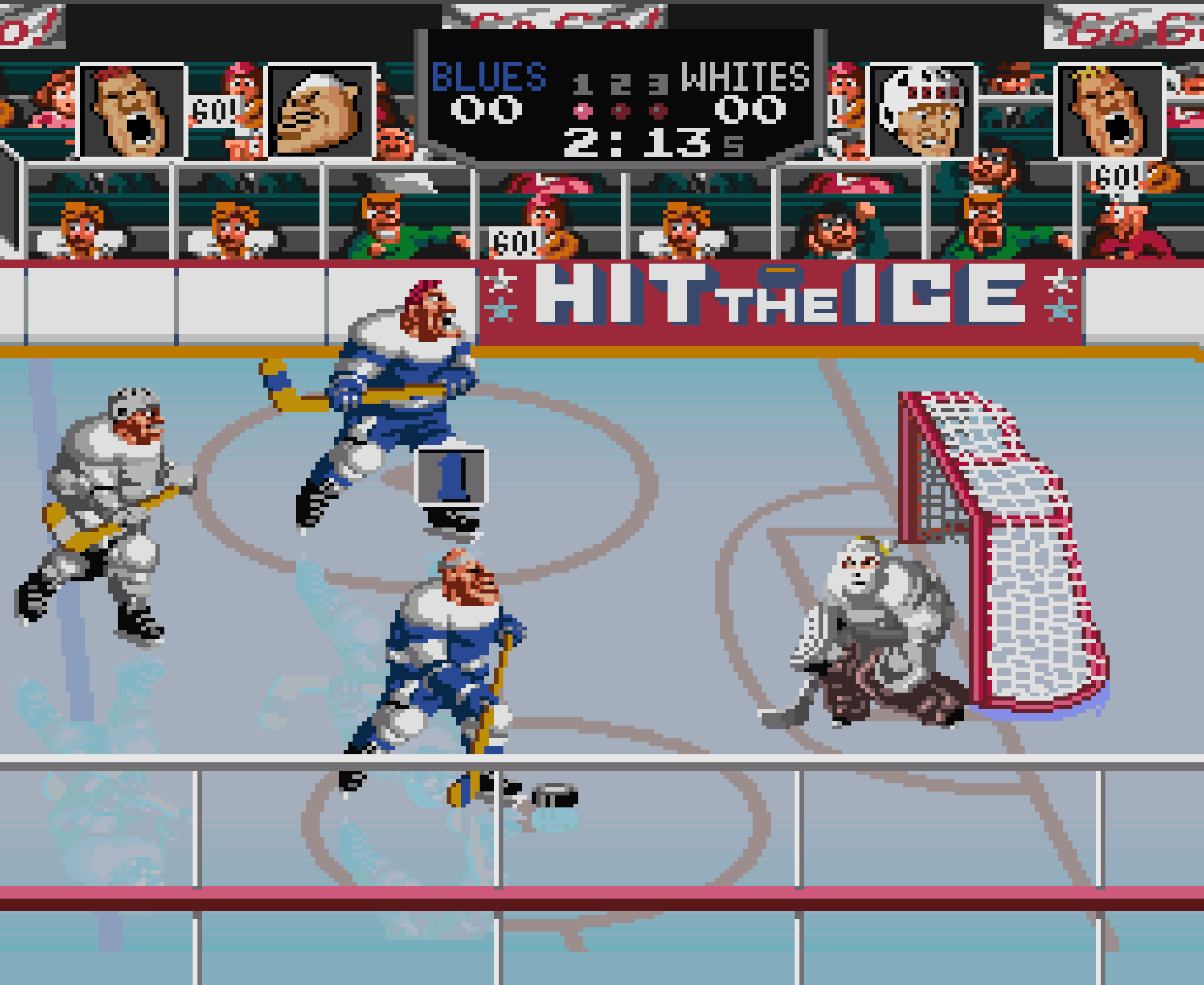
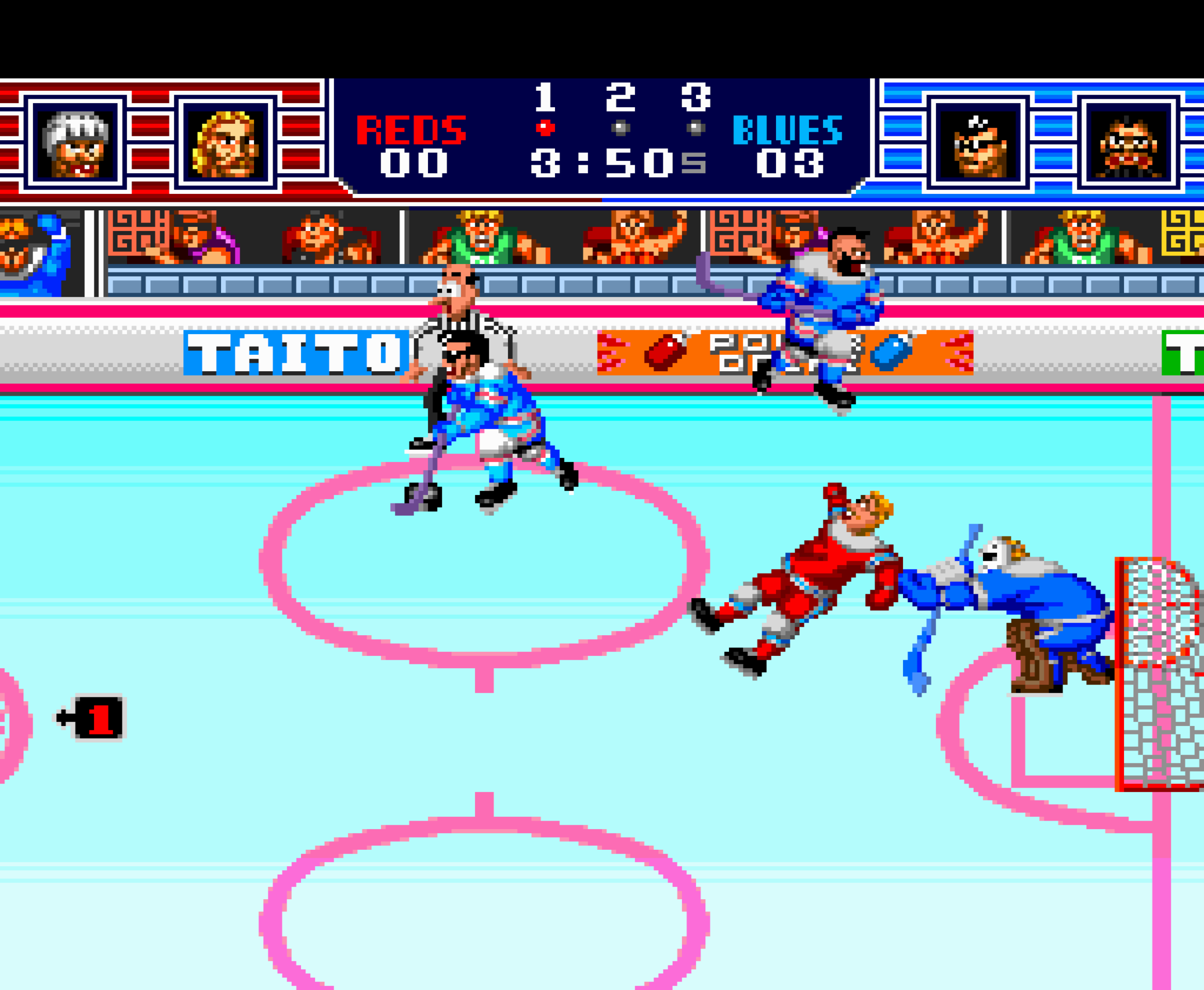
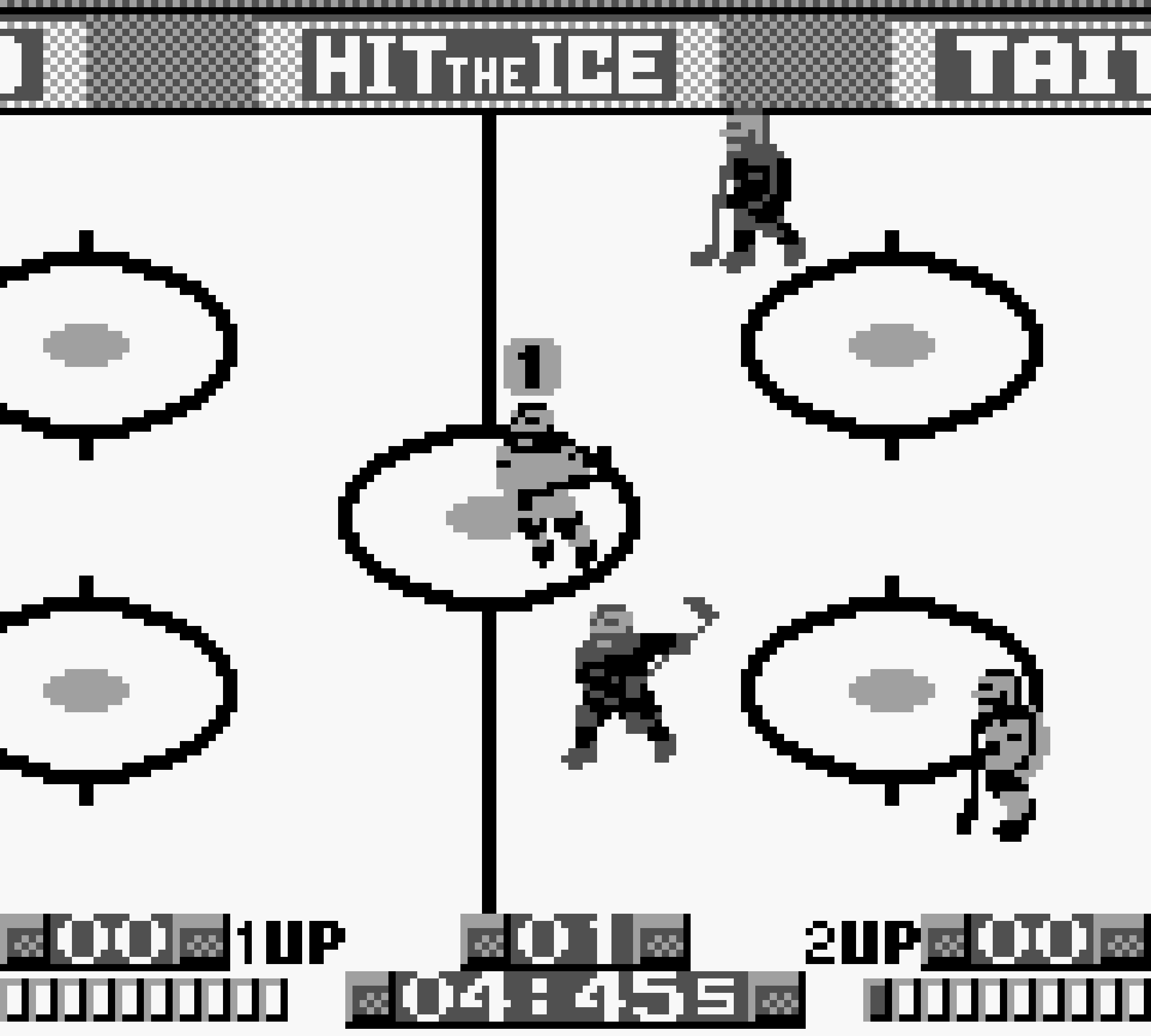
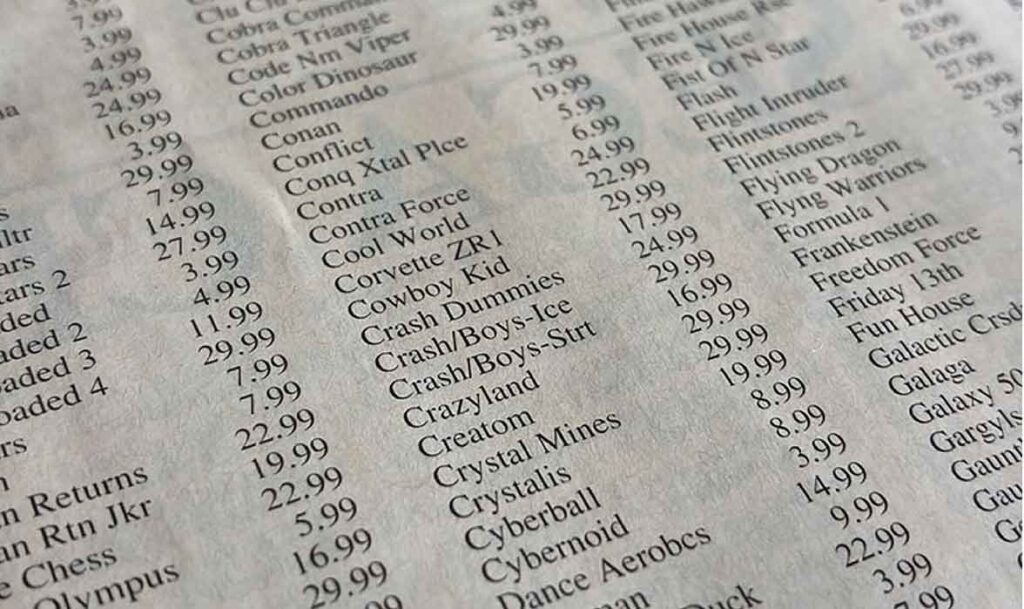
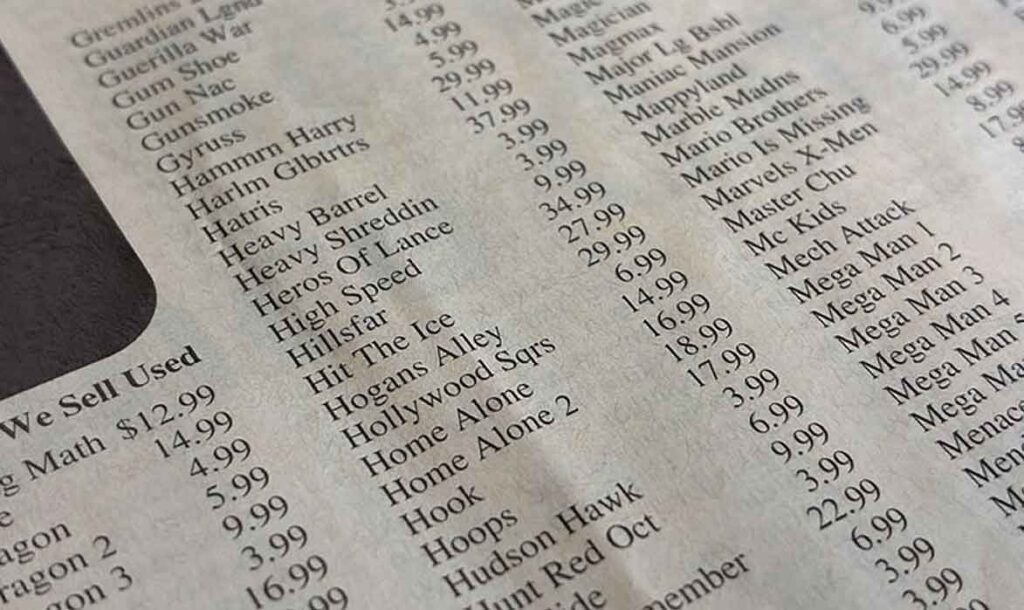
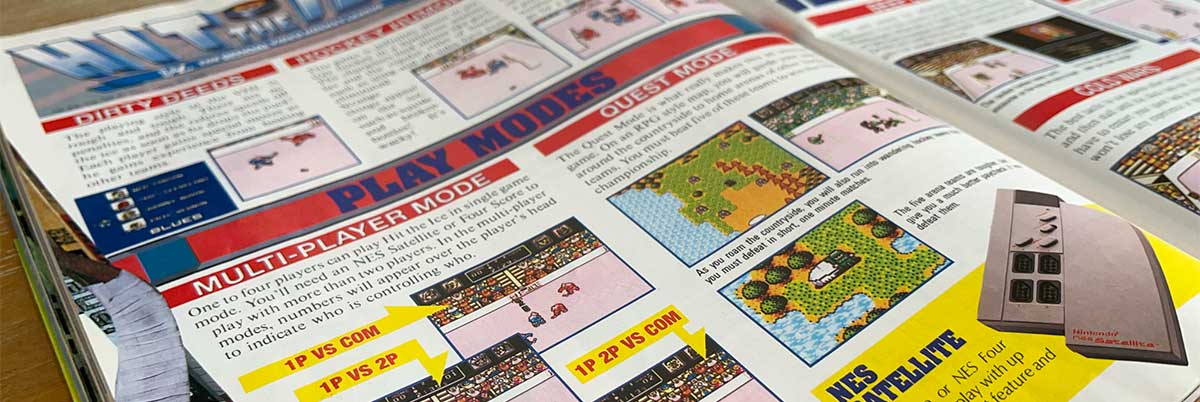
At the time there was plenty of preview coverage indicating that an NES port was in development. Nintendo Power dedicated space to Hit the Ice in three consecutive issues, culminating in a two-page feature in issue 49. The November 1992 issue of Electronic Gaming Monthly listed an NES version in their Next Wave Directory section, and it appeared in preorder listings from mail order services like the Funco Video Game Fall Catalog 1994. (Oddly, Ice Challenge also appears in both places.) Of course the game never was released, joining the ranks of extremely late-gen NES games that were teased but never saw the light of day.
In 2002 a prototype was found and ripped by games historian Frank Cifaldi. That in-process draft, still a little clunky and featuring some translation issues, revealed a near-finished port of the arcade game that paled in comparison to the already limited home versions. The gameplay was fundamentally the same, but its small NES sprites were unable to convey the manic energy of the arcade original. Later, the 2020 Nintendo “Gigaleak” apparently contained the game’s fully-completed source code. Cifaldi’s Twitter thread from the time confirmed the game’s submission and approval for publication in March 1993.
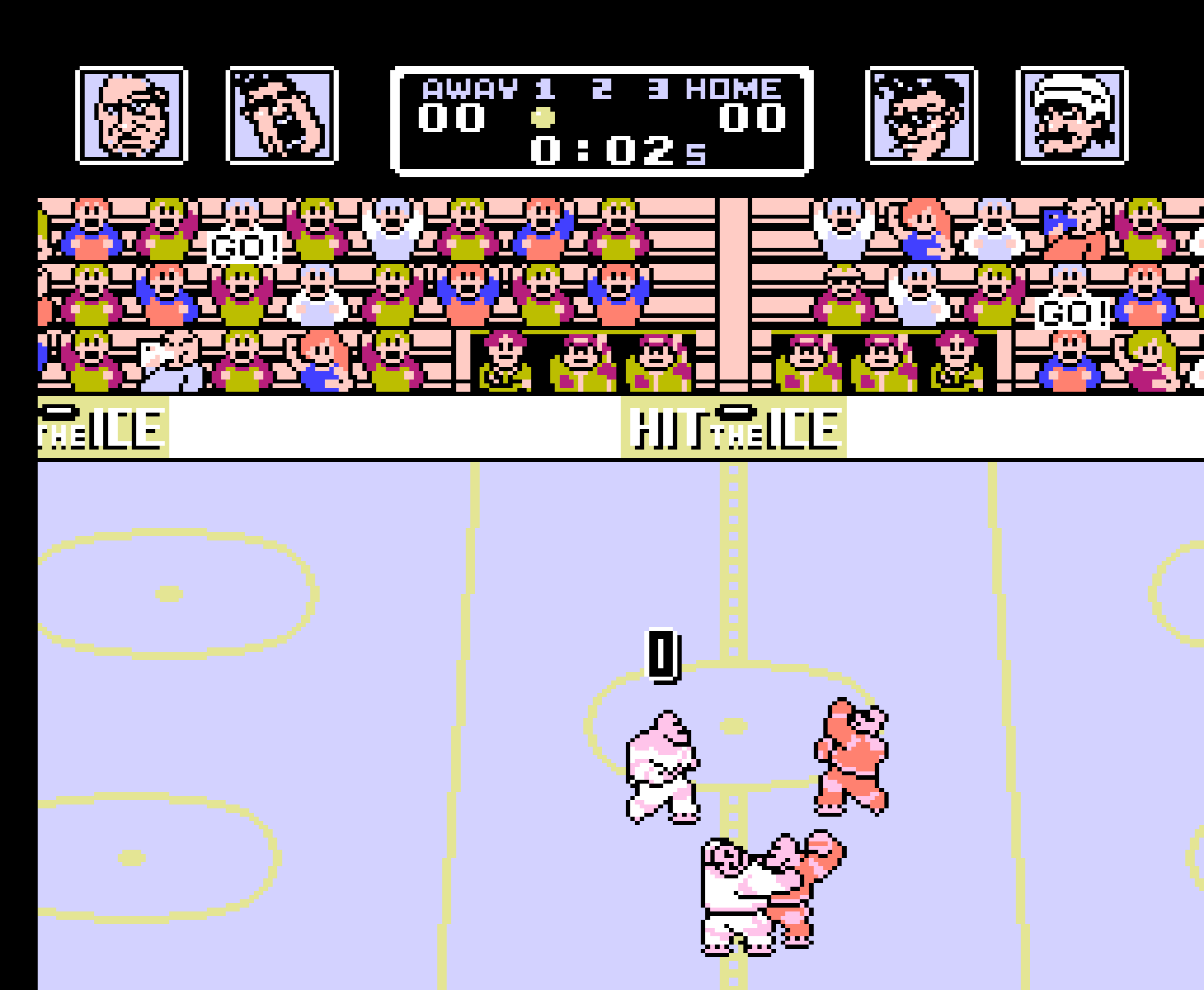
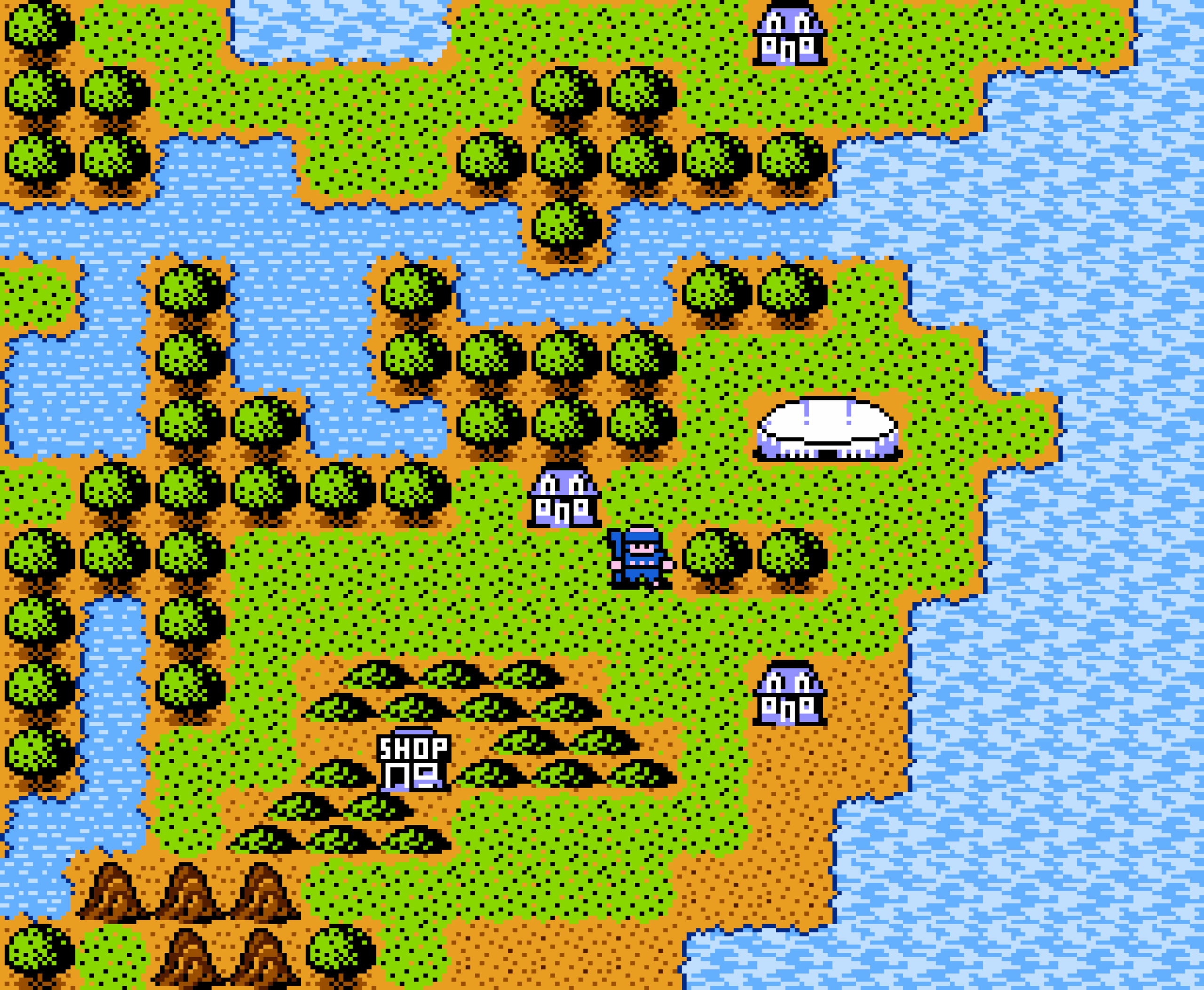
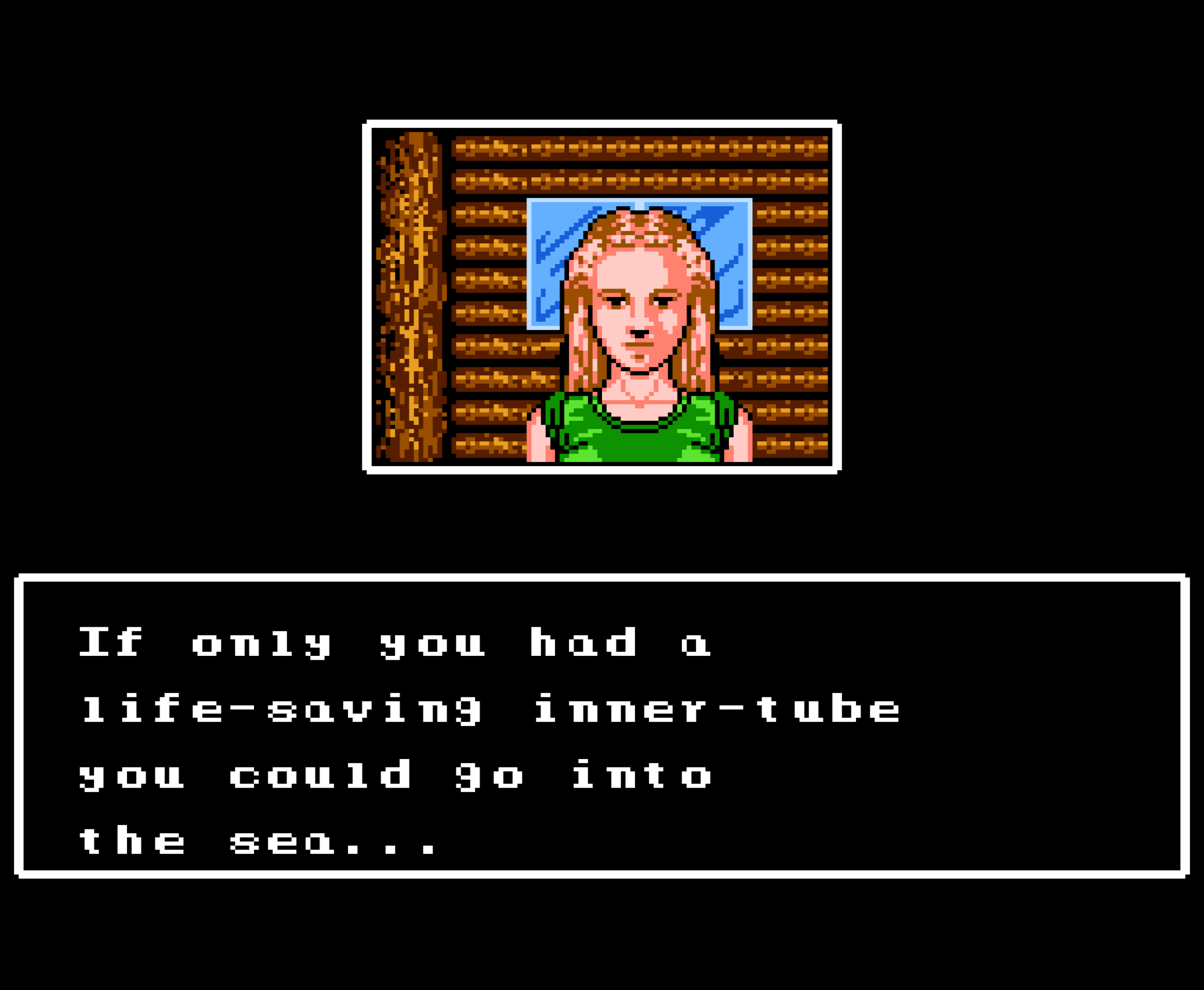
You get the sense that whatever team at Taito was porting Hit the Ice knew there wasn’t enough here to call it a full game. In addition to the standard arcade modes, the game’s main menu defaults to something called “1P Quest.” There were small hints at a deeper game in some of the 16-bit ports, but NES Hit the Ice goes head first into something that’s basically Dragon Quest with a little hockey thrown in. After choosing a team and players, and a pep talk from the team owner, you are presented with an overworld map and a few points of interest: some houses, a shop, and your home arena. Your player avatar is a stubby little hockey guy, in full pads and stick in hand, wandering the countryside and looking for information about how to get to the VHL championship. Random battles occur Dragon Quest-style, with the screen cutting away to a black background and text declaring, “The (fill in a color)’s team has appeared.” This is 1P Quest’s one deviation from the standard NES RPG; battles are fought by playing one minute of conventional Hit the Ice. Win and you gain experience points and gold, lose and you are sent back to your home arena for a scolding from the owner. (Nothing in particular happens after a tie, which I guess the VHL and the NHL of this era had in common.)
This is a brief, fascinating glimpse of a game that could have been, something that wields the depth of a fantasy RPG toward wildly incongruous ends. I would have guessed the game was simply unpolished as a prototype, lacking defined quests or items and equipment beyond a few in-game power ups, but the differences between this and the final copy were apparently minor. It’s a shame, because the quest mode’s one-minute intervals benefit the experience. Hit the Ice was never intended to be played for more than a few minutes in its original form, and the sixty-second random battles avoid growing tedious. Just a little more depth could have gone a long way, like allowing your team to spend gold on better equipment, or a little more variety among the enemy encounters.
Instead, what’s here feels basic, like it was the first draft of a deeper game. Or maybe it simply is what it appears to be on the surface: an odd experiment bolted on to a game that was growing more unlikely by the month. If the NES version was intended to be released with the Genesis and TG-16 versions, it was (like the SNES version) a few months behind schedule. There were only about fifty games released for the NES, in the US, in 1993. If they kept pace for a mid-year release (assuming some minimum production turnaround after certification, and considering Nintendo Power gave it April and later May 1993 release windows), Hit the Ice would have been one of the final handful of games released for the console.
It’s fair to wonder if the developers snuck in the RPG mode because, by this point, no one was paying attention. You get the sense that they were getting away with something; if it was earlier in the console’s lifecycle I wonder if Taito would have mandated a straightforward adaptation.
It’s odd that both games were so close to releasing at the same time, as if there was something in the water. Perhaps developers felt more leeway to experiment with hockey, since it was less familiar in Japan than sports like soccer or baseball. Its kinetic nature is an ideal fit for arcadey action, and the absence of real-life strategy allowed creators to entertain some fun diversions. Of the hockey games that were released for the NES, none had an NHL license and only two had real players: Wayne Gretzky Hockey and (future collectible) Pro Sport Hockey. Sadly, there was never a Tecmo Stanley Cup.
Still, it seems that there was an ambient drift away from the Famicom’s arcade roots toward something slower and more considered. By 1993 we were starting to see a trend of RPG systems in NES games, especially in cases that didn’t necessarily feel like a natural fit. It’s hard to pin down why. It could have been that advances in chip hardware allowed for deeper systems, or maybe that developers (especially in Japan) were inspired by early console RPGs.
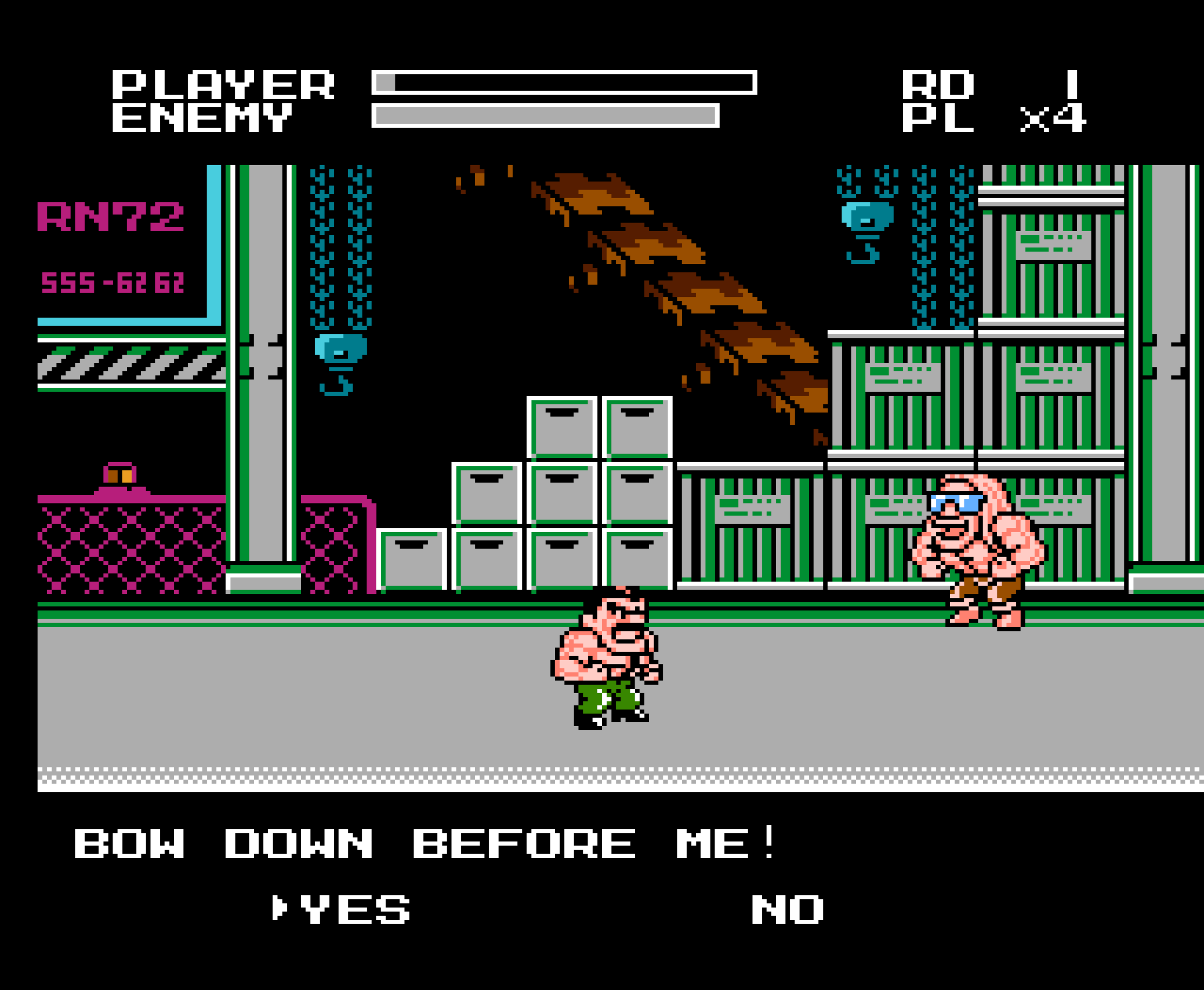
It’s also possible that RPG mechanics, for late-gen NES games, were a response to the graphical advances of 16-bit consoles. By this point the NES was something of a kid-sibling system, and if it couldn’t compete with state-of-the-art visuals, perhaps some stats-based depth could make up for these shortcomings. Mighty Final Fight couldn’t hold up to the SNES version visually, but it made up for it with experience points and dialogue options. Contra Force had its issues as a pure action game, but its selectable characters were essentially player classes, and it gave players the ability to call in NPCs to deal with specific situations—summons, if you will. Even Adventure Island 3—part of a series premised on twitch action—introduced an overworld map and persistent items.
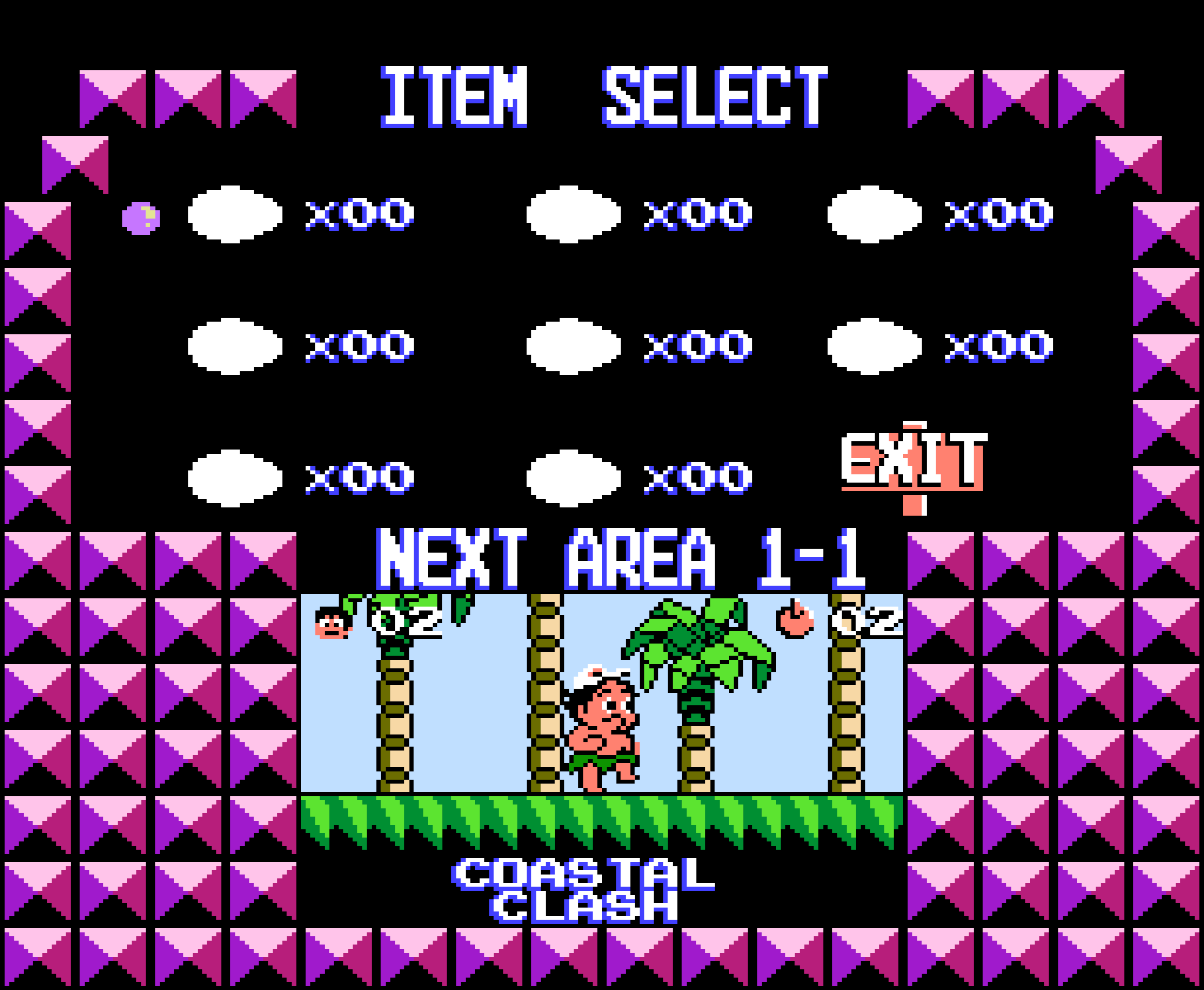
Briefly, it seemed as if introducing RPG flavor was the key to making relevant games at the later stages of aging hardware.
Despite the trend Hit the Ice and Crash ‘n’ the Boys: Ice Challenge suggested, sports RPGs are still fairly unusual. Occasionally you’ll get outliers like Game Boy Color’s Mario Golf and Mario Tennis, or an indie project like Golf Story, but largely there’s a separation between the two genres. Maybe there’s something superfluous about a conscious attempt to mix the two. Both are heavily stats-based, and managing player stats in a season mode already feels a bit like character progression. Anyway, the push toward league-exclusive licenses for team sports games removed some of developers’ room to experiment with story and world building, at least until recent experiments with secondary modes.
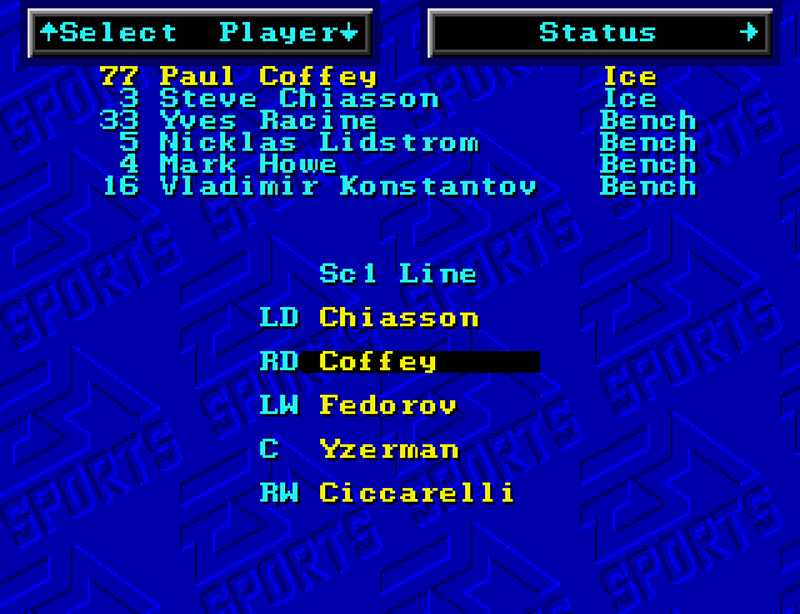
By the time these games were slated for release, Electronic Arts’ NHL series had already revolutionized video game hockey, refining (if not outright introducing) features such as full NHL rosters, teams, and simulated playoff series. If they had met their original mid-1993-ish release dates, the NES hockey RPGs would have been published mere months before the immortal NHL ‘94.
After decades of evolution—and Be a Pro modes aside—the NHL series did begin to boomerang around back into RPG territory. NHL 11 introduced Hockey Ultimate Team, a secondary mode that effectively turns the NHL series into a collectable card game. Like Pokémon TCG or Magic: the Gathering, Ultimate Team is centered on deck building and deployment. The key difference is utilization; packs unlock players, arenas and jerseys, which are used to ice a team in an otherwise standard exhibition game.
Ultimately, the tradition of hockey RPGs—or at least hockey games with incongruous genre mechanics—found a second life in the PC indie game market. A quick search for “hockey” in Steam turns up all sorts of odd experiments. Super Blood Hockey combines Ice Hockey’s visuals with goofy hyperviolence and a story-based franchise mode that mostly plays out off of the ice. Goons: Legends and Mayhem mixes air hockey with fantasy trappings. Journey Bound Games’ upcoming Wild Ice reimagines hockey mechanics as a post-apocalyptic survival sim. Game Time Glizzys ignores the game altogether in favor of manning an arena concession stand.
Perhaps the ultimate successor to the hockey RPG experiment is Excellent Rectangle’s Tape to Tape. As with Hit the Ice and Ice Challenge, there’s a conventional, if cartoonish, simulation of the sport at its core. (It’s product description defines this hybrid as “simcade.”) Tape to Tape also continues Hit the Ice’s abbreviated on-ice gameplay. Challenges play out in limited two-minute periods, or sometimes until a certain condition is met (e.g. first goal scored).
Tape to Tape’s overworld map (tapetotapegame.com)
Many standard RPG hallmarks are present—named characters with stats, a store offering buffs, post-combat dialogue, an overworld map—but Tape to Tape organizes its between-match skill progression in a Roguelite format. The game’s campaign mode is run-based, offering a variety of talent and skill upgrades after wins, branching paths with strategic implications, and a chance to buy permanent upgrades between each failed attempt. For all of the game’s attention to detail the developers seem fully aware of the clash between Roguelites’ typically-medieval appearance and hockey’s blunt anti-aesthetic, relishing the juxtaposition. Your shopkeeper and between-run narrator is a blacksmith forging a hockey stick.
Maybe this sense of playfulness, without sacrificing the deeper systems, is what we have been missing. Stats-heavy hockey management sims are now common and have a long history. (And irreverent hockey games have basically existed as long as there’s been arcades.) But there was something anarchic in the spirit of the NES hockey RPGs, now reflected in the passion of indie projects, that undermined the assumed rules of the day. It was an odd moment where the category distinctions had yet to ossify, and a pair of studios found (or nearly found) an unlikely hybrid genre decades ahead of its time.

Hit the Ice image by The Arcade Flyer Archive, Fair use, https://en.wikipedia.org/w/index.php?curid=13011928